



A Year Focused on Clarity, Control, and Confidence
Architecture and engineering firms operate in a uniquely complex environment. Projects are long. Teams are multidisciplinary. Client's demands are growing. Competition is increasing. Financials are deeply tied to how work is planned, staffed, tracked, and billed. And leaders are expected to make smart decisions long before the outcomes are visible.
In 2025, our product roadmap stayed grounded in that reality.
Every release this year was guided by a simple goal: help Architecture and Engineering firms run with more clarity, more control, and more confidence. That meant reducing manual work, tightening the connection between projects and financials, and giving firm leaders better visibility into what is happening now and what is coming next.
This Year in Review highlights the most meaningful product advances from 2025, focusing on the key releases that moved the needle for architecture and engineering firms. Taken together, they tell a clear story. One where the product acts as a trusted guide, helping firms navigate growth, complexity, and change without losing control of their business.
Q1 2025: Building a Stronger Financial Foundation
The first quarter of 2025 focused on one of the most critical areas for architecture and engineering firms: financial structure and control.
As firms grow, financial complexity grows with them. More projects. More people. More transactions. Without strong foundations, leadership teams are often forced to rely on spreadsheets, manual adjustments, and delayed reporting to understand how the business is really performing.
Q1 set out to change that by strengthening the financial core of CORE and giving firms better discipline, accuracy, and visibility from day one.
Accounting Periods & Closed Period Controls
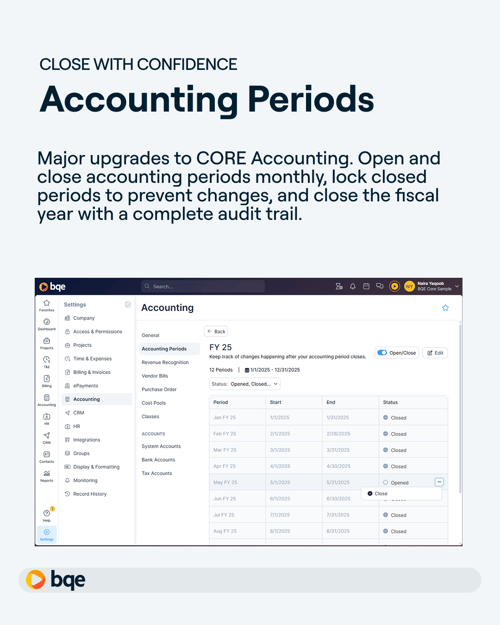
Accounting Periods introduced the ability to formally define fiscal years and open and close books on a monthly basis, bringing much-needed structure and discipline to financial workflows. By preventing uncontrolled backdated changes, firms gained greater confidence in the integrity of their financial data.
At the same time, Closed Period enhancements ensured that control did not come at the expense of practicality. Firms can now update select billing-related fields for time and expense entries in closed periods, with full audit tracking and permission controls in place. This allows teams to correct issues when needed without reopening the books or compromising financial integrity.
Together, these capabilities deliver cleaner month-end closes, more reliable financial statements, and the confidence to move forward without constantly revisiting the past. Leaders can trust the numbers, finance teams can work more efficiently, and the firm benefits from a system that balances rigor with real-world flexibility.
Automated Revenue Recognition
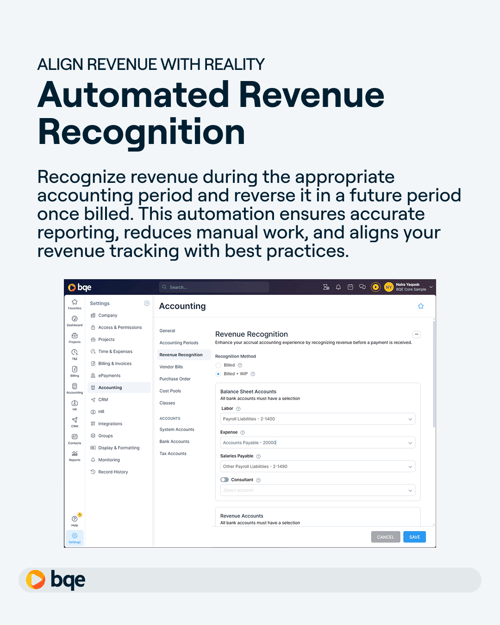
Automated Revenue Recognition helped firms align revenue with how work is actually delivered.
By recognizing revenue and costs based on billed activity or billed plus work in progress, firms gained a more accurate, real-time view of project performance. This is especially valuable for long-running or phased projects where relying solely on invoicing can obscure the true financial picture.
With revenue recognition automated and standardized, leadership teams can make better decisions earlier, while accounting teams spend less time managing manual adjustments.
Accounting Transaction Audit Trail Enhancements
Transparency is essential as firms scale. Q1 enhancements to the accounting transaction audit trail made it easier to trace, review, and explain transactions across CORE.
Every adjustment and transaction is now clearer and easier to follow, supporting internal reviews, external audits, and day-to-day confidence in the system. This level of visibility helps firms operate with greater accountability and reduces risk as complexity increases.
Cloud Feeds Enhancements
Improvements to Cloud Feeds focused on automation, accuracy, and reconciliation.
Enhanced rules and matching logic reduced manual cleanup while improving the reliability of bank feed data flowing into CORE. For accounting teams, this meant fewer exceptions to manage and faster reconciliation cycles. For firm leaders, it meant financial data that stays current without constant intervention.
Q2 2025: Turning Planning Into a Competitive Advantage
While Q1 focused on financial structure, Q2 shifted attention to how work gets planned, staffed, and delivered.
For architecture and engineering firms, project planning is where strategy meets reality. When planning tools are rigid or disconnected, teams end up reacting instead of leading. Q2 addressed this head-on by making planning more flexible, more visual, and far more connected to day-to-day decision-making.
Project Planner Launch and Enhancements
Q2 marked a major milestone with the launch and continued enhancement of Project Planner.
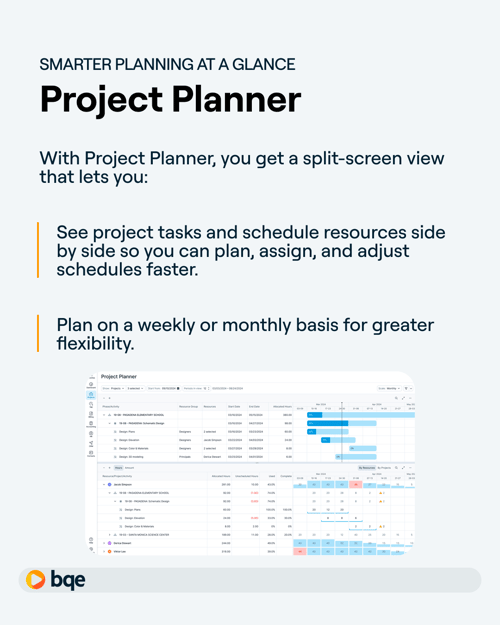
Firms gained more intuitive ways to plan work and manage resources, including improved allocation editing, clearer timelines, and more powerful filtering. Teams could adjust schedules directly within the planner, visualize workload over time, and quickly identify where resources were stretched or underutilized.
By making planning faster and more accessible, Project Planner helped firms move from static schedules to living plans that evolve alongside projects. Because those plans are backed by real-time time entry data, principals can trust that forecasts, staffing decisions, and workload views are grounded in actual effort, not guesswork.
Forecasting Enhancements
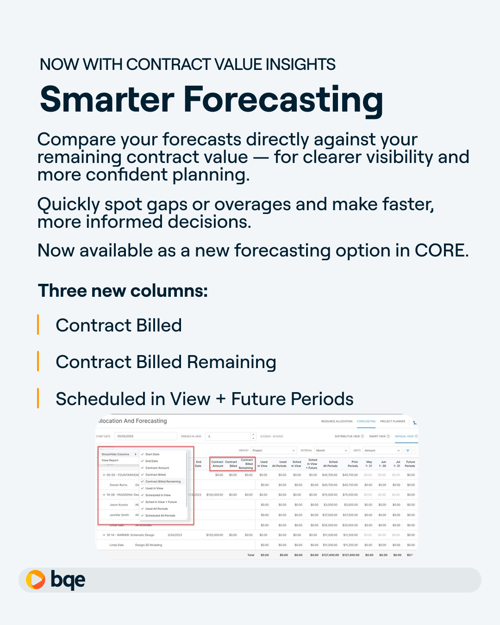
Forecasting improvements gave firm leaders a clearer window into the future.
New columns and expanded visibility into workload and capacity made it easier to understand how upcoming work aligns with available staff. Instead of guessing or relying on offline spreadsheets, firms could see potential issues earlier and make proactive adjustments.
This level of foresight supports smarter hiring decisions, better backlog management, and more sustainable growth.
A Best-in-Class Mobile Experience for A&E Firms
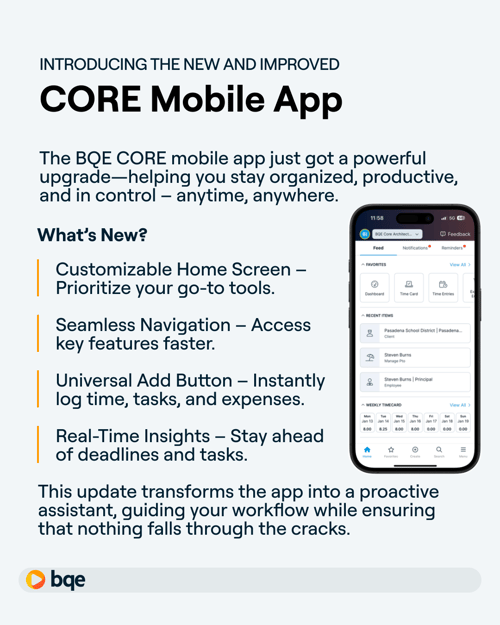
Q2 delivered meaningful improvements to the CORE mobile experience, reinforcing mobile as a reliable way to run day-to-day operations, not just a convenience for time entry.
Navigation and usability enhancements, including persistent bottom navigation and more consistent save actions, made it easier for teams to move quickly and accurately through CORE on the go. These improvements reduced friction for staff and supported more consistent use across the firm.
For firm leadership, the impact is straightforward. When mobile tools are intuitive and dependable, adoption increases. Better adoption leads to timelier time entry, cleaner data, and more reliable Project KPIs. By continuing to invest in mobile, CORE strengthened its position as a best-in-class mobile platform for architecture and engineering firms.
Simplified Project Manager Permissions
As firms grow, permission complexity can slow teams down.
Simplified Project Manager permissions made it easier to define what PMs can see and do, without overengineering security profiles. This struck a better balance between control and autonomy, empowering project leaders while maintaining firm-wide governance.
Q3 2025: Reducing Friction and Accelerating Cash Flow
With strong financial foundations in place and clearer planning tools available, Q3 focused on speed, automation, and connection.
For many architecture and engineering firms, growth does not stall because of lack of demand. It stalls because of friction. Manual billing steps. Disconnected tools. Time lost chasing payments or re-entering data. Q3 tackled these challenges by automating routine workflows and tightening the connection between CORE and the broader firm tech stack.
Automated Invoice Reminders & Smarter Billing Communication and Collections
Q4 introduced meaningful improvements to how firms manage billing communication, balancing the need for timely payment with the importance of maintaining strong client relationships.
Automated Invoice Reminders help firms get paid faster by delivering consistent, professional follow-up on unpaid invoices without relying on manual reminders or ad hoc outreach. This reduces administrative effort for finance teams and improves cash-flow predictability across the firm.
At the same time, principals retain full control. Invoice reminders can be disabled at the client or individual invoice level, making it easy to accommodate special arrangements or high-touch relationships where a more personal approach is required.
Support for multiple billing contacts per project further strengthens this workflow. Firms can now include additional internal or client stakeholders on billing-related communications without changing invoice formatting, ensuring the right people stay informed and reducing follow-up questions.
Together, these updates create a billing process that runs reliably in the background, supports healthier cash flow, and reinforces trust with clients, while freeing leadership and staff to focus on higher-value work.

CORE Zapier Connector
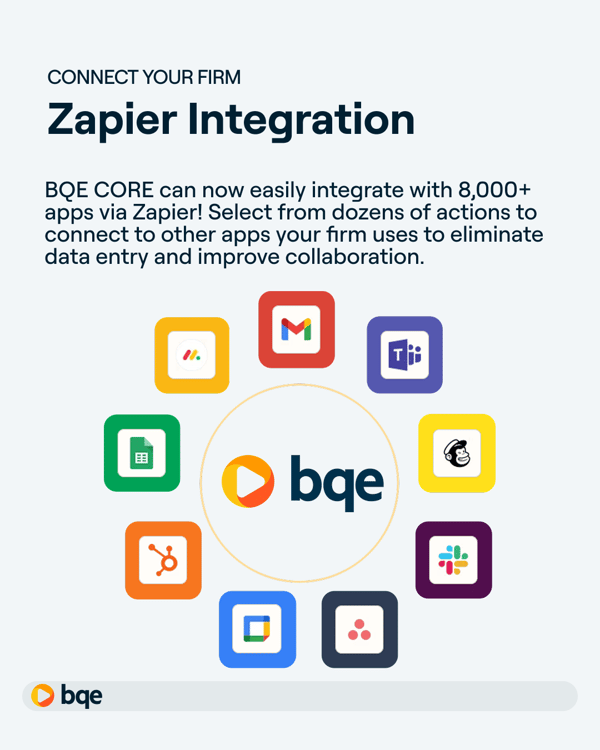
CORE has long had an open architecture with out-of-the-box integrations, APIs, webhooks, and a Power BI connector. With the CORE Zapier Connector, firms can now build connections to almost any tools they are using.
With Zapier, firms can integrate CORE with thousands of applications, automating workflows across marketing, project management, communication, and operations. Time entries, project updates, and invoice data can move seamlessly between systems, eliminating duplicate data entry and reducing errors.
This flexibility allows firms to build workflows that match how they operate, not the other way around.
Projects List View Enhancements - KPI Powerup
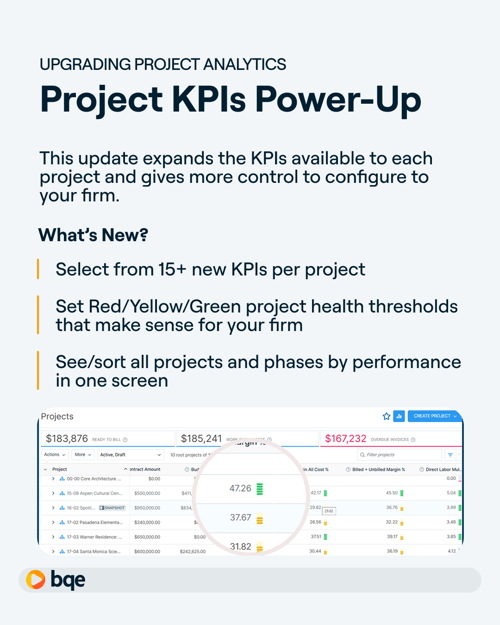
Q3 enhancements to the Projects List View made it easier for firms to manage a growing portfolio of work without losing visibility or control.
Project managers gained the ability to edit more fields in-line, reducing friction and keeping project data current as work progresses. At the same time, key Project KPIs surfaced directly in the list view, giving leaders immediate insight into percent complete, billed progress, and overall project health without drilling into individual records.
By reducing navigation and putting critical indicators front and center, teams can spend less time managing the system and more time managing the work. For principals, this translates into faster pattern recognition across projects and earlier intervention when risk or opportunity emerges.
Q4 2025: Built for Scale, Payroll, and Multi-Entity Firms
The final quarter of 2025 delivered some of the most transformative capabilities of the year. These updates were designed for firms operating at a greater scale, across multiple entities, and with increasing operational complexity.
Q4 focused on unifying people, projects, and financials in ways that reduce manual effort while dramatically improving visibility.
CORE Payroll, Powered by Gusto
One of the most significant releases of the year was CORE Payroll.
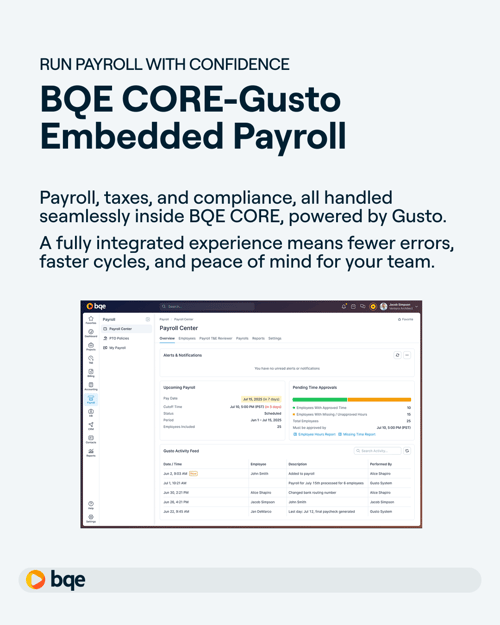
Payroll has traditionally lived outside core project and financial systems, forcing firms to manually move data between systems and reconcile time, payroll, and project costs after the fact. CORE Payroll changes that model.
Powered by Gusto and built directly into CORE, Payroll connects approved time entries to payroll processing, and administrators can quickly turn those entries into payroll runs. As soon as payroll is processed, labor costs are reflected in project financials.
This gives firm leaders near real-time insight into their largest expense and a clearer understanding of true project margins. Finance teams spend less time reconciling systems, and project managers gain faster feedback on performance.
Daily Time Cards
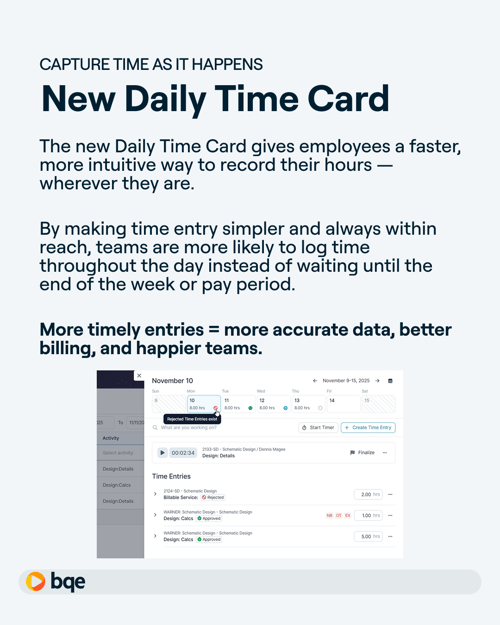
Q4 also introduced Daily Time Cards, a meaningful shift in how firms capture the most important data in the system: time.
For many architecture and engineering firms, time entry has historically been a weekly or even retroactive task. While familiar, that approach often leads to incomplete data, delayed visibility, and missed insight into how projects are actually performing.
Daily Time Cards encourage teams to log time as work happens. By making daily entry easier and more intuitive, firms can improve accuracy, reduce end-of-week scrambles, and build a healthier habit around time tracking.
For principals, the value is clear. More timely time entries lead to more reliable Project KPIs, better visibility into utilization and burn rates, and faster feedback on project performance. When time data is current, the firm can respond sooner, course-correct earlier, and make decisions with greater confidence.
Over time, this small behavioral change compounds into better planning, more accurate billing, and stronger financial outcomes across the firm.
Automated Intercompany Billing by Class
For firms managing different offices, regions, or disciplines, Q4 introduced Automated Intercompany Billing.
Using Class-based logic, CORE now automatically transfers labor and expense costs between entities when employees work on projects owned by a different entity. These transfers happen seamlessly as part of normal workflows and are recorded with detailed journal entries.
This removes one of the most time-consuming manual processes for multi-entity firms while ensuring financials accurately reflect how resources are used.
Monthly Distributed Backlog Report
The Monthly Distributed Backlog Report gave firm leaders a clearer, forward-looking view of revenue and workload.
By distributing contract balances across future months, firms can better forecast revenue, plan staffing, and identify gaps or risks earlier. This transforms backlog from a static number into a planning tool that supports smarter decision-making.
A Consistent Theme: Less Guesswork, Better Decisions
Looking back on 2025, a few themes stand out.
First, integration mattered. Projects, people, time, billing, payroll, and accounting moved closer together. Data flowed more freely. Gaps closed. This was true within CORE, but also with how CORE can integrate across all the software that firms use in their day-to-day work.
Second, automation replaced manual effort. Whether through invoice reminders, revenue recognition, intercompany billing, or integrations, repetitive work faded into the background.
Third, visibility improved. Leaders gained clearer insight into backlog, workload, utilization, WIP, AR, and profitability, not just at a moment in time, but across the future.
This is what it means for the product to act as a guide. Not by overwhelming firms with features, but by quietly removing friction and illuminating the path forward.
Looking Ahead
The progress made in 2025 sets the stage for what comes next.
With stronger financial foundations, more practical planning tools, deeper automation, and support for complex firm structures, architecture and engineering firms are better equipped to grow with intention. And we are building the next generation of powerful features to help firms grow stronger and faster. From AI advisors to powerful data insights, CORE is primed to power the future success of A/E firms.
As always, these updates were shaped by real-world feedback from firms navigating real challenges. That collaboration continues to drive the roadmap forward.
Here’s to the teams who build our communities, and to the tools that help them do their best work with clarity and confidence.
Why You Should See CORE for Yourself
If you’re responsible for running the business side of an architecture or engineering firm, the improvements highlighted here are just a handful of the benefits. Better visibility. Fewer manual workarounds. More confidence in the numbers. Less friction across teams. Faster billing. Easier use for the whole firm.
That’s exactly what CORE is designed to deliver.
For engineering and architecture firms with 10 or even 200+ people, CORE brings projects, time, billing, payroll, and financials into one connected system, so you can spend less time managing tools and more time leading the firm. It delivers from proposal to paid.
If you’re evaluating how to move beyond spreadsheets, disconnected systems, or legacy software, the best next step is to see CORE in action. Book a personalized demo today.