


CORE Pursuit is now live! Our reimagined CRM helps firms turn a complicated pipeline into a repeatable process for winning work. It keeps opportunities visible, helps teams create stronger proposals faster, and connects every pursuit to the projects and revenue that follow. Sign up for the live demo >
Architecture school is an incredible place to learn how to design. You might even learn about structural systems, environmental performance, and how to convince a jury that your conceptual model represents a "bold new approach to urban living".
What you probably won't learn is how to find someone willing to pay you to build it.
For all the emphasis placed on design excellence, the business of winning work remains a terribly neglected part of architectural education. Engineering graduates face much the same problem. They enter the profession with sophisticated technical skills, only to discover that running a successful practice requires an entirely different set of abilities.
Most professionals learn these skills through trial and error, often while managing demanding project schedules and wondering why their firm's cash flow seems to have a mind of its own.
The result is an industry filled with extraordinarily capable people who know how to manage complex projects, yet struggle to manage the process that brings those projects through the door.
The Most Important Project Nobody Is Managing: Winning Work
Consider how an architecture or engineering firm approaches a typical client project.
There are phases, budgets, schedules, deliverables, responsibilities, and regular reviews. Teams track progress, evaluate risks, and document decisions. When something goes wrong, there's usually a process for getting things back on track.
Now consider how that same firm approaches business development.
Perhaps a principal meets a developer at an industry event, or an existing client mentions plans for another facility. Maybe a project manager learns about an upcoming infrastructure RFP.
What happens next often depends on who heard about the opportunity, whether they remember to follow up, and how effectively that information is shared.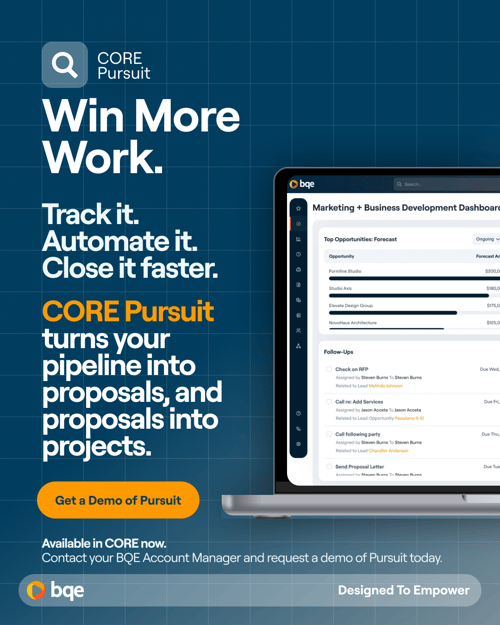 Some opportunities make their way into spreadsheets or a CRM system. Others remain buried in email conversations or floating around inside the heads of busy principals.
According to Zweig Group's 2025 Marketing + Business Development Report, only 26% of A/E firms follow a formal, firm-wide pursuit planning process for key opportunities. Meanwhile, the median proposal win rate sits around 33%.
That's a considerable investment of professional time going into opportunities that never become paying projects.
For an industry facing persistent pressure on fees and profitability, it deserves more scrutiny.
Treat Business Development Like a Project
Imagine applying the same discipline to business development that architects and engineers already apply to their technical work.
Every opportunity would have a defined stage, an accountable owner, and a next action. Firms would understand which pursuits were progressing, which required attention, and which were unlikely to justify further investment.
Douglas Teiger, FAIA, offers a practical starting point in his forthcoming book, The Profitable Practice:
"At a minimum, you want a running record of every prospect, rated on their likelihood to sign, the quality of the project or client, and where they sit in your pipeline."
Teiger recommends distinguishing between prospects, active leads, submitted proposals, signed contracts, lost opportunities, stalled projects, and work deliberately declined.
These distinctions help firms understand where opportunities are getting stuck, how effectively proposals convert into contracts, and whether their business development efforts are producing desirable work.
The same information can support financial planning. With visibility into likely wins, anticipated fees, and start dates, firms can make better decisions about staffing, workload, and capacity.
Bringing Order to the Pipeline
One reason business development remains difficult to manage is that the technology available to A/E firms has often been poorly suited to their workflows.
Generic CRM systems are typically designed around conventional sales processes. Architecture and engineering firms develop opportunities through relationships, technical qualifications, and detailed proposals that may take months to become signed contracts.
Once a project is won, the information developed during the pursuit becomes essential to delivering the work.
This is where BQE CORE Pursuit offers an opportunity.
Built into CORE, Pursuit helps firms manage opportunities, track their pipeline, and prepare proposals using existing information. When a pursuit succeeds, relevant details can carry into project delivery, reducing duplicate entry and disconnected workflows.
Over time, connecting pursuit activity with project and financial information can help firms understand which clients, project types, and strategies produce the best results. Software alone won't make a firm better at winning work. Leadership still needs to establish expectations and make business development a regular part of operations. But having the right information in the right place makes that discipline considerably easier.
Architecture and engineering firms expertly coordinate complex teams, manage demanding schedules, and solve extraordinarily difficult technical problems.
Now they need to apply the same rigor to winning work.
See the new way of winning architecture and engineering work: Sign up for the live demo of CORE Pursuit >