


CORE Pursuit is now live! This reimagined CRM helps firms turn a complicated pipeline into a repeatable process for winning work. It keeps opportunities visible, helps teams create stronger proposals faster, and connects every pursuit to the projects and revenue that follow. Sign up for the live demo >
Winning a major project is cause for celebration. The announcement goes out, the backlog gets updated, and someone might even bring doughnuts to the office.
Then everyone moves on to the next opportunity.
But there's a question that rarely gets asked:
How much did it cost to win?
Architects and engineers can tell you exactly how many hours went into a project's construction documents. Ask how many hours went into winning that same project, and the accounting gets a little more creative.
The principal's relationship-building time, marketing team's proposal work, technical contributions from senior staff, and interview expenses may be scattered across different budgets or recorded inconsistently.
By the time the project begins, much of that effort has disappeared from view. Which is convenient, if you're trying to maintain the illusion that business development is free.
The Real Cost of Winning Work
According to the AIA's 2024 Firm Survey, firms allocate an average of 8% of net billings to marketing and business development staff costs, plus another 4% in direct expenses.
That's a significant investment to manage without understanding its return. Particularly for an industry that will happily spend three hours debating a $200 change order.
Consider two projects with identical fees. One comes through an established client relationship and requires minimal proposal preparation. The other demands months of positioning, technical submissions, interviews, and enough PowerPoint revisions to qualify as a separate project.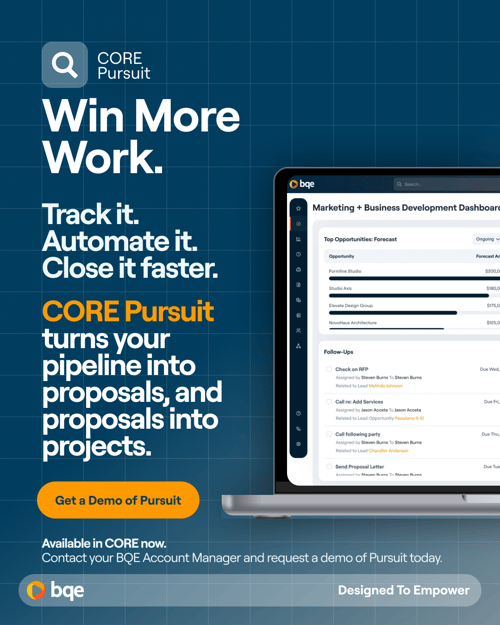
Both appear as equivalent wins in a pipeline report, but their economics are very different.
And the financial story continues after the contract is signed.
A project that initially looks attractive may deliver disappointing margins because of an aggressive fee or poorly defined scope. The team then spends the next eighteen months discovering exactly how aggressive that fee was.
Without connecting pursuit information to project performance, firms struggle to learn from those outcomes. They know which projects they won, but have a harder time identifying which ones were worth winning.
Connect Pursuit to Profitability
In his forthcoming book, The Profitable Practice, Douglas Teiger, FAIA, recommends tracking business development activity alongside financial and project metrics: "The value isn't in any single month's number. It's in watching the trend, and knowing, with real data instead of a gut feeling, whether what you're doing is working."
BQE CORE Pursuit helps firms establish that connection by bringing opportunity tracking, proposal development, and pipeline management into CORE.
Firms can track the time invested in pursuing opportunities, maintain a clearer picture of their pipeline, and use that information to make more informed decisions about where to focus their efforts. When an opportunity becomes a project, relevant information can carry into delivery, reducing duplicate entry and preserving the details behind the original proposal. Because nobody should have to retype the same project information into three different systems and call it a workflow.
Connecting pursuit history with project outcomes can help firms identify which clients and project types produce the strongest returns, improve forecasting, and make more informed decisions about future work.
Architecture and engineering firms spend years refining their technical expertise and learning from completed projects. They conduct lessons-learned meetings, review budgets, and investigate why a detail that looked perfectly reasonable on paper became a $40,000 problem in the field.
Business development deserves the same scrutiny.
Winning a project is an important milestone, but it tells only part of the story.
The more interesting question is whether the firm would make the same investment to win that project again — and whether it has the information needed to answer that…
…ideally before submitting another 80-page proposal.
See the new way of winning architecture and engineering work: Sign up for the live demo of CORE Pursuit >