



Learn how to calculate and apply the engineering KPIs that will drive your business. Get formulas, examples, and verified benchmarks for your firm, engineering team, and engineering managers, and see how to put them into action. Download KPI worksheets to get started.
Inside This Article
Engineering KPIs measure how engineering firms convert labor, time, and expertise into financial performance, delivery reliability, and team stability. KPIs differ from metrics because they tie directly to business objectives at the firm, team, and manager levels. Core engineering KPIs include profitability, utilization, realization, cash flow, delivery, quality, and growth measures. Standard formulas and industry benchmarks provide context for evaluating performance, allowing you to compare your firm against industry-wide best practices. Firm-level KPIs focus on revenue, margins, and efficiency. Team KPIs track workload balance, execution, and quality. Manager KPIs assess planning accuracy, retention, and predictability. KPI combinations reveal operational risk, performance trends, and improvement opportunities. Worksheets and dashboards support consistent tracking and automation.
Engineering KPIs vs. Metrics: Different Uses
Engineering KPIs are measurements directly tied to business objectives, while metrics are the supporting data points used to monitor individual activities. KPIs show whether your firm is meeting large-scale strategic goals. Metrics help diagnose the factors that drive those goals.
Engineering KPIs typically place attention on profitability, efficiency, delivery, and client value. Your organization may track dozens of metrics, but it should use select KPIs to inform firm-level decisions.
According to Ed Walsh, Founder of Rockland CFO, the “most effective KPIs for engineering firms are those that connect project-level decisions to firm-level results. By focusing on a core set of metrics, leaders gain access to the operational health and performance of the organization, allowing them to make improvements when necessary.”
Most engineering firms track 8 to 12 core KPIs at the firm level and 5 to 8 KPIs for departments, teams, or individual managers. These ranges keep performance measurement focused and actionable without overwhelming staff.
Your KPIs should include a mix of leading indicators and lagging indicators:
- Leading indicators point to what’s likely to happen next. For instance, trends in proposal win rate, forecasted utilization, and early change orders can reveal whether future workload, staffing pressure, or project risk is building long before those effects show up in financial results.
- Lagging indicators reflect what has already happened. Profit margin, net multiplier, realization rate, and revenue growth spotlight the outcomes of earlier decisions on pricing, staffing, and delivery. Together, leading indicators guide action while lagging indicators confirm impact.
For more, see our AE firm KPI guide.
Engineering Firm KPI Formulas, Examples, and Benchmarks
Engineering firm KPIs illuminate how well a firm converts labor into revenue, manages costs, and delivers profitable projects. These KPIs help you judge efficiency and monitor the financial and operational flow of your project, team, or overall firm.
Get the BQE 2025 Engineering Benchmarking Report for more. Also, see our article on benchmarking for AE firms.
Engineering Net Multiplier (or Billing Multiplier)
The net multiplier measures how well your firm converts direct labor into net revenue, defined as the amount left after deducting pass-through and subconsultant costs. It is a staple KPI for A/E firms and one of the most commonly benchmarked.
Engineering Net Multiplier Formula: Net Revenue ÷ Direct Labor Cost
If a project earns $150,000 in net revenue and has $50,000 in direct labor cost, the multiplier is 150,000 ÷ 50,000 = 3.0. This shows how effectively the firm turns labor cost into revenue.
Engineering Net Multiplier Benchmark Range
- Average: 3.21
- Typical Range: 2.5–4.0
- High Performance: 3.3 and above
Source: BQE 2025 Engineering Benchmarking Report, Billing Multiplier
Engineering Project Profit Margin
This refers to the percentage of net revenue remaining after you subtract all project-related costs and indicates whether a project is appropriately priced and managed.
Engineering Project Profit Margin Formula: (Net Revenue − Total Project Costs) ÷ Net Revenue × 100
A project earning $200,000 with $150,000 in costs has a margin of (200,000 − 150,000) ÷ 200,000 × 100 = 25%. This indicates whether the project yields an acceptable profit.
Engineering Project Profit Margin Benchmark Range
- Average: 20.9%
- Typical Range: 13%–32%
- High Performance: ≥ 24%
Source: BQE 2025 Engineering Benchmarking Report, Profit %,
Engineering Overhead Multiplier
The overhead multiplier helps firms understand administrative, operational, and non-billable burdens and their relative burden on revenue-producing work. It’ll calculate how much indirect cost the firm carries relative to direct labor costs.
Engineering Overhead Multiplier Formula: Total Overhead Costs ÷ Direct Labor Cost
If overhead totals $900,000 and direct labor is $300,000, the overhead multiplier is 900,000 ÷ 300,000 = 3.0. This reflects the indirect cost burden carried by each dollar of direct labor.
Engineering Overhead Multiplier Benchmark Range
- Average: 1.56
- Typical Range: 0.8–2.2
- High Performance: ≤ 1.4
Source: BQE 2025 Engineering Benchmarking Report, Overhead Multiplier
Engineering Operating Margin
Operating margin shows how much profit remains after operating expenses. This KPI reflects how well your firm covers overhead, manages labor, and generates returns from its service delivery model.
Engineering Operating Margin Formula: Operating Income ÷ Net Revenue × 100
A firm earning $10 million in revenue with $1.5 million in operating income has a margin of 1.5M ÷ 10M × 100 = 15%. This assesses how the firm converts revenue into operating profit.
Not included in BQE's Benchmarking Report.
Engineering Days Sales Outstanding (DSO)
Days sales outstanding (DSO), also called average collection period or accounts receivable days, shows how long it takes for customers to pay their bills. This key performance indicator shows how well your billing is working and how stable your cash flow is. It highlights any collection concerns that could affect a project's or a company's financial performance.
Engineering DSO Formula: (Accounts Receivable ÷ Annual Credit Sales) × 365
If AR totals $1 million and annual credit sales are $8 million, AR Days = 1M ÷ 8M × 365 = 45.6 days. This reflects how quickly clients pay their invoices.
Engineering DSO Benchmark Range
- Average: 57 days
- Typical Range: 36.7–71.3 days
- High Performance: ≤ 45 days
Source: BQE 2025 Engineering Benchmarking Report, Average Collection Period
Engineering Revenue Growth Rate
The revenue growth rate KPI shows how revenue increases over time. It demonstrates how successfully the firm is growing, the level of market demand, and the ability to retain customers while raising the value of contracts and services.
Engineering Revenue Growth Rate Formula: (Current Period Revenue − Prior Period Revenue) ÷ Prior Period Revenue × 100
If revenue grows from $12 million to $15 million, the rate is (15M − 12M) ÷ 12M × 100 = 25%. This shows the firm’s pace of expansion.
Engineering Revenue Growth Rate Benchmark Range
- Average: 13.26%
- Typical Range: –7% to 25%
- High Performance: ≥ 15%
Source: BQE 2025 Engineering Benchmarking Report, YoY Revenue Growth
Engineering Proposal Win Rate (Bid-to-Win)
Proposal win rate is the percentage of submitted proposals that turn into awarded projects. It indicates business development efficiency, competitiveness, and scope effectiveness, pricing, and client qualification processes.
Engineering Proposal Win Rate Formula: Number of Wins ÷ Number of Proposals Submitted × 100
If a team submits 20 proposals and wins 6, the win rate is 6 ÷ 20 × 100 = 30%. This measures business development effectiveness.
Engineering Proposal Win Rate (Bid-to-Win) Benchmark Range
- Average: 50%
- High Performance: 55% and up
Source: Rockland CFO
Rockland’s Ed Walsh notes that these rates will skew lower for firms that bid a lot of work, whereas more disciplined forms who target their strengths in bidding will see a higher win rate.
Engineering Revenue per Employee
This key performance indicator measures how effectively you generate revenue relative to staffing levels. It provides a wide view of productivity and the balance between labor and project demand.
Engineering Revenue per Employee Formula: Total Revenue ÷ Total Number of Employees
A firm generating $10 million with 50 employees has revenue per employee of 10M ÷ 50 = $200,000. This shows overall productivity relative to staffing.
Engineering Revenue per Employee Benchmark Range
- Average: $171,612
- Typical Range: $117,028–$188,842
- High Performance: $185,000+ per FTE
Source: BQE 2025 Engineering Benchmarking Report, Revenue/FTE
Engineering Billable Utilization Rate
The rate evaluates the share of available hours you’ve spent on a project. This is one of the most critical measures of financial health as it affects revenue, staffing calls, and your profitability.
Engineering Billable Utilization Rate Formula: Billable Hours ÷ Total Available Hours × 100
An engineer billing 32 of 40 available hours has 32 ÷ 40 × 100 = 80% utilization. This indicates how much of their time is spent on revenue-producing work.
Engineering Billable Utilization Rate Benchmark Range
- Average: 67%
- Typical Range: 53-77%
- High Performance: 77%
Sources: BQE 2025 Engineering Benchmarking Report, Utilization Rate, and Rockland CFO.
Rockland’s Walsh suggests that the typical range for the billable utilization rate will vary depending on staff roles. For example, technical staff should see a higher average billable utilization rate, approximately 80%, while PMs and leadership will trend lower.
Engineering Department and Team KPIs
The engineering department and team KPIs look at the effective use of resources, budget, and deadline targets, and client expectations. These key performance indicators help leaders assess workload balance, execution, and quality. These are important KPIs for monitoring whether your projects are improving.
Engineering Resource Utilization Rate
This calculates how well you apply a team’s available hours to project work. It helps you see workload distribution, project bottlenecks, and staffing concerns related to project demand.
Engineering Resource Utilization Rate Formula: Project Hours Worked ÷ Total Available Team Hours × 100
If a team works 250 project hours out of 400 available hours logged, the rate is 250 ÷ 400 × 100 = 62.5%. This shows how effectively the team’s capacity is being used.
Engineering Resource Utilization Rate Benchmark Range
- Average: 67%
- Typical Range: 53% - 77%
- High Performance: ≥ 65% (note that higher isn't necessarily better. It is about striking a balance between billable work and non-billable time like training and professional development, team building, mentoring, marketing, etc. Further, on an individual basis, each role could have a drastically different Utilization Rate target. It also can vary from team to team, based on their responsibilities.)
Source: BQE 2025 Engineering Benchmarking Report, Utilization Rate
Engineering Realization Rate
Realization rate is a measure of how much of your team’s billable work translates into revenue once write-downs and adjustments are taken into account. This KPI shows the accuracy of the scope and project efficiency.
Engineering Realization Rate Formula: Billed Revenue ÷ Billable Work Value × 100
If a team produces $120,000 of billable work but only $100,000 is billed, the rate is 100,000 ÷ 120,000 × 100 = 83.3%. This reveals revenue lost to write-downs or scope issues.
Engineering Realization Rate Benchmark Range
- Average: 87%
- Typical Range: 82% - 97%
- High Performance: ≥ 90%
Source: BQE 2025 Engineering Benchmarking Report, Realization Rate
Engineering Project On-Time Delivery Rate
This key performance indicator tracks the percentage of project milestones completed on schedule. It helps you visualize and manage your team’s ability to manage workloads, anticipate risks, and avoid delays.
Engineering Project On-Time Delivery Rate Formula: On-Time Deliverables ÷ Total Deliverables × 100
If 18 of 20 milestones are delivered on schedule, the delivery rate is 18 ÷ 20 × 100 = 90%. This reflects reliability and workflow stability.
Engineering Project On-Time Delivery Rate Benchmark Range
- Average: 65%
- Typical Range: 55-70%
- High Performance: 75%
Source: PMI Pulse of the Profession and PMO industry studies
Engineering Budget Variance
Budget variance is the difference between planned and actual project spending. This KPI shows drift of scope, issues in scheduling, and operational inefficiencies that can sometimes cause projects to go over budget.
Engineering Budget Variance Formula: (Actual Cost − Budgeted Cost) ÷ Budgeted Cost × 100
If a project budgeted at $500,000 ends at $550,000, the variance is (550,000 − 500,000) ÷ 500,000 × 100 = 10% over budget. This signals cost control issues.
Engineering Budget Variance Benchmark Range
- Average: 55-65% of projects on or under budget
- Typical Range: 50-70%
- High Performance: 70-75%
Source: Infinite CXO Industry Benchmark Report
Engineering Client Satisfaction (CSAT/NPS)
Client satisfaction scores show how clients feel about the quality, communication, and overall experience with your team. This helps identify service gaps and whether project delivery has met expectations.
Engineering Client Satisfaction Formula (CSAT): Number of Positive Ratings ÷ Total Ratings × 100
A team receiving 42 positive ratings out of 50 surveys has 42 ÷ 50 × 100 = 84% CSAT. This captures perceived service quality.
No benchmarking ranges available.
Engineering Net Promoter Score (NPS) Formula: % Promoters − % Detractors
If 60% are promoters and 15% detractors, NPS = 60 − 15 = 45. This indicates long-term client loyalty and referral potential.
No benchmarking ranges available.
Engineering Change Order Rate
This KPI tracks the degree to which projects change in scope once work has begun. A high change order rate may indicate issues in scope, shifting client requirements, and gaps in planning or coordination
Engineering Change Order Rate Formula: Number of Change Orders ÷ Total Projects × 100
If 8 of 25 projects required change orders, the rate is 8 ÷ 25 × 100 = 32%. This may point to scoping or communication challenges.
Engineering Change Order Rate Benchmark Range
-
Average: 8-12% of contract value
-
Typical Range: 5-15%
-
High Performance: 5-8%
Source: UDA Construction
First Pass Yield / Rework Rate
First Pass Yield is the percentage of work completed on the first pass without revisions or changes. Rework rate measures the opposite: the amount of work that has required multiple attempts to complete. These two KPIs, taken together, reveal how well your team produces accurate deliverables and how much effort is required to correct issues.
First Pass Yield Formula: Deliverables Approved on First Review ÷ Total Deliverables × 100
If 45 of 60 deliverables are approved without revision, FPY = 45 ÷ 60 × 100 = 75%. This measures quality and efficiency.
Rework Rate Formula: Deliverables Requiring Rework ÷ Total Deliverables × 100
If 15 of 60 deliverables require rework, rework rate = 15 ÷ 60 × 100 = 25%. This indicates how often time is lost to corrections.
First Pass Yield Benchmark
- Average: 88%
- Typical Range: NA
- High Performance: NA
Source: Construction Industry Institute (CII)
Rework Rate Benchmark
- Average: 12%
- Typical Range: NA
- High Performance: NA
Source: Construction Industry Institute (CII)
Engineering Manager KPIs
Engineering manager KPIs emphasize how work is planned, teams are developed, and outcomes are met. These performance indicators spotlight whether you’re allocating resources properly, retaining employees, and delivering on predictable schedules. Strong engineering manager KPIs can signal healthy teams and stable performance.
Engineering Planning Accuracy
Planning accuracy is the extent to which your actual staffing and timelines match the initial plan. This reflects how well a manager realistically estimates workload, resources, and constraints.
Engineering Planning Accuracy Formula: Planned Hours ÷ Actual Hours × 100
If a manager plans 1,000 hours and the project requires 1,100, accuracy is 1,000 ÷ 1,100 × 100 = 90.9%. This reflects the realism of estimates.
No available benchmarking data.
Engineering Employee Utilization Balance
This KPI evaluates how evenly a manager assigns team workloads. It helps identify cases with labor overloads or underutilization; certain patterns may affect the team’s morale and long-term retention.
Engineering Employee Utilization Balance Formula: (Standard Deviation of Individual Utilization Rates)
If team members’ utilization varies widely, the standard deviation rises; a tighter range means better balance. This highlights workload equity across a manager’s team.
No available engineering-specific benchmarking data. This KPI is best analyzed by its consistency or variability, as detailed above.
Engineering Team Turnover Rate
Team turnover rate is the key performance indicator that tracks how often employees leave a team within a given period. High turnover is indicative of workload concerns, flawed expectations, or gaps in leadership and communication while low turnover is a signal of stability and effective management.
Engineering Team Turnover Rate Formula: Departures ÷ Average Headcount × 100
If three employees leave a 20-person team in a year, turnover is 3 ÷ 20 × 100 = 15%. This measures team stability.
Engineering Team Turnover Rate Benchmark Range
- Average: NA
- Typical Range: 10-18%
- High Performance: NA
Source: SHRM & AIA HR trends on A/E industry turnover
Engineering Training Hours per Employee
This KPI measures the time each team member spends on training and professional development. It can reflect management’s commitment to skill-building, career paths, and overall team health. It also signals a team’s readiness to tackle emerging technologies or evolving demands.
Engineering Training Hours per Employee Formula: Total Training Hours ÷ Number of Employees
If the team logs 240 training hours across 12 employees, the rate is 240 ÷ 12 = 20 hours per employee. This reflects investment in skill development.
There’s no available engineering-specific benchmarking data at this time, but as staff training is a focus for many firms in the engineering industry, one can expect standards to be established in the future. Training hours per employee is a metric that firms can assess internally using agreed-upon training goals and establishing ongoing benchmark ranges for comparative analysis.
Source: Rockland CFO
Engineering Staff Retention Rate
Staff retention rate tells a manager how many employees remain on a manager’s team over a set period of time. This helps measure team health, the effectiveness of leadership, and support for long-term project engagement.
Engineering Staff Retention Rate Formula: (Employees at Period End − New Hires) ÷ Employees at Start × 100
If a team starts with 25 employees and ends with 24 after hiring two, retention is (24 − 2) ÷ 25 × 100 = 88%. This shows how many original team members stayed.
Engineering Staff Retention Rate Benchmark Range
- Average: NA
- Typical Range: 82-90%
- High Performance: NA
Source: Derived from SHRM & AIA HR trends on A/E industry turnover
Engineering Average Project Margin per Manager
This helps you see the profitability and effectiveness of projects under a single manager’s leadership. It spotlights how well a manager deploys resources and creates efficiencies across their portfolio.
Engineering Average Project Margin per Manager Formula: Total Margin of Managed Projects ÷ Number of Projects Managed
If a manager oversees five projects totaling $600,000 in margin, the average is 600,000 ÷ 5 = $120,000 per project. This ties leadership effectiveness to project profitability.
There’s no available benchmarking data due to the wide variety of project sizes and profit target numbers.
Firms interested in this metric are well-served by studying past performance in this area to establish internal benchmark ranges for future assessments.
Engineering Forecast Accuracy
Forecast accuracy is a measure of how well a manager predicts revenue, resource needs, and project scope. A strong accuracy measure suggests good planning and reporting, while weak accuracy scores point to volatility in planning and management.
Engineering Forecast Accuracy Formula: Forecasted Value ÷ Actual Value × 100
If a manager forecasts $4 million in revenue and actual revenue is $4.2 million, accuracy is 4M ÷ 4.2M × 100 = 95.2%. This shows the reliability of forecasting.
Engineering Forecast Accuracy Benchmark Range
- Average: 75-85%
- Typical Range: 70-90%
- High Performance: ≥90%
Source: Derived from cross-industry general forecast literature.
Engineering Project Delivery Predictability
This KPI tracks the consistency of a manager’s ability to meet timelines, budgets, and other standards. It is an indicator or reliability in leadership and a team’s ability to deliver work without big surprises and last-minute corrections.
Engineering Project Delivery Predictability Formula: Projects Delivered as Planned ÷ Total Projects × 100
If 14 of 18 projects meet planned timelines and budgets, predictability is 14 ÷ 18 × 100 = 77.8%. This captures overall delivery consistency.
Engineering Project Delivery Predictability Benchmark Range
- Average: 40-50% of projects on time and on budget
- Typical Range: 30-60%
- High Performance: 60-75%
Source: KPMG 2023 Global Construction Survey
The 10 KPIs Your Engineering Firm Needs To Be Tracking
In this webinar, Steve Burns, FAIA, discusses how to use engineering KPIs to drive performance across your business. He discusses the metrics, how to calculate them, what they mean, and how you can work on improving them so your business sees sustained success.
Engineering KPI Formulas at a Glance
|
Engineering Firm KPIs |
Engineering Department / Team KPIs |
Engineering Manager KPIs |
|
Engineering Net Multiplier Formula: Net Revenue ÷ Direct Labor Cost |
Engineering Resource Utilization Rate Formula: Project Hours Worked ÷ Total Available Team Hours × 100 |
Engineering Planning Accuracy Formula: Planned Hours ÷ Actual Hours × 100 |
|
Engineering Project Profit Margin Formula: (Net Revenue – Total Project Costs) ÷ Net Revenue × 100 |
Engineering Realization Rate Formula: Billed Revenue ÷ Billable Work Value × 100 |
Engineering Employee Utilization Balance Formula: Standard Deviation of Individual Utilization Rates |
|
Engineering Overhead Multiplier Formula: Overhead Costs ÷ Direct Labor Cost |
Engineering Project On-Time Delivery Rate Formula: On-Time Deliverables ÷ Total Deliverables × 100 |
Engineering Team Turnover Rate Formula: Departures ÷ Average Headcount × 100 |
|
Engineering Operating Margin Formula: Operating Income ÷ Net Revenue × 100 |
Engineering Budget Variance Formula: (Actual Cost – Budgeted Cost) ÷ Budgeted Cost × 100 |
Engineering Training Hours per Employee Formula: Total Training Hours ÷ Number of Employees |
|
Engineering Days Sales Outstanding (DSO) Formula: (Accounts Receivable ÷ Annual Credit Sales) × 365 |
Engineering Client Satisfaction (CSAT/NPS) Formula (CSAT): Positive Ratings ÷ Total Ratings × 100 Formula (NPS): % Promoters – % Detractors |
Engineering Staff Retention Rate Formula: (Employees at End – New Hires) ÷ Employees at Start × 100 |
|
Engineering Revenue Growth Rate Formula: (Current Period Revenue – Prior Period Revenue) ÷ Prior Period Revenue × 100 |
Engineering Change Order Rate Formula: Number of Change Orders ÷ Total Projects × 100 |
Engineering Average Project Margin per Manager Formula: Total Project Margin ÷ Number of Managed Projects |
|
Engineering Proposal Win Rate (Bid-to-Win) Formula: Wins ÷ Proposals Submitted × 100 |
First Pass Yield (FPY) Formula: Deliverables Approved on First Try ÷ Total Deliverables × 100 |
Engineering Forecast Accuracy Formula: Forecasted Value ÷ Actual Value × 100 |
|
Engineering Revenue per Employee Formula: Total Revenue ÷ Number of FTE Employees |
Formula: Deliverables Requiring Rework ÷ Total Deliverables × 100 |
Engineering Project Delivery Predictability Formula: Projects Delivered as Planned ÷ Total Projects × 100 |
|
Engineering Billable Utilization Rate Formula: Billable Hours ÷ Total Available Hours × 100 |
Engineering KPI Cheat Sheets by Category
These cheat sheets help you organize the most important project metrics so your teams can quickly find the KPIs that best support their roles and responsibilities. For actual tracking tools, see our companion article on engineering KPI templates, dashboards, and reports.
You can also use the BQE Benchmarking Calculator to compare your metrics with leading industry data.
Engineering Firm KPI Cheat Sheet
Download the Engineering Firm KPI Cheat Sheet in Excel or Google Sheets
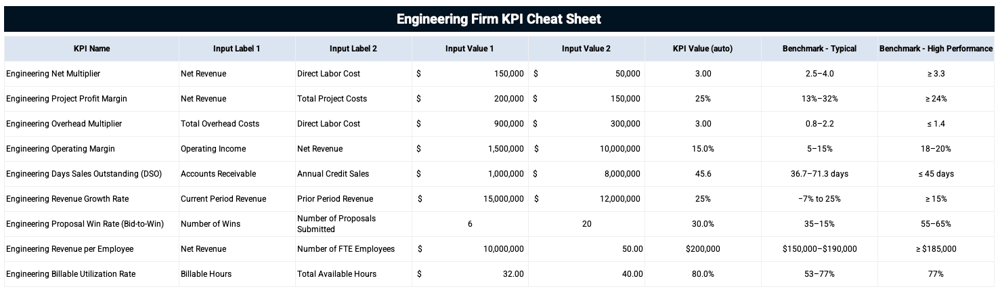
The Engineering Firm KPI Cheat Sheet offers a summary of the financial and productivity metrics you should be tracking. It includes metrics such as net multiplier, project profit margin, operating margin, revenue per employee, and billable utilization rate. The sheet includes both an example tab and a blank tab for you to fill in.
Engineering Department/Team KPI Cheat Sheet
Download the Engineering Department/Team KPI Cheat Sheet in Excel or Google Sheets
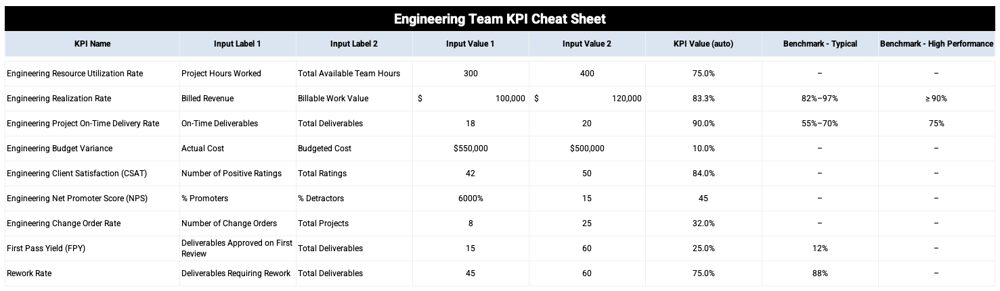
This cheat sheet outlines KPIS that show how effective your team is in the use of resources, management of scope, and delivery. It includes formulas and benchmarks for resource utilization rate, realization rate, budget variance, client satisfaction rate, change order rate and first pass yield. The sheet includes both an example tab and a blank tab.
Engineering Manager KPI Cheat Sheet
Download the Engineering Manager KPI Cheat Sheet in Excel or Google Sheets
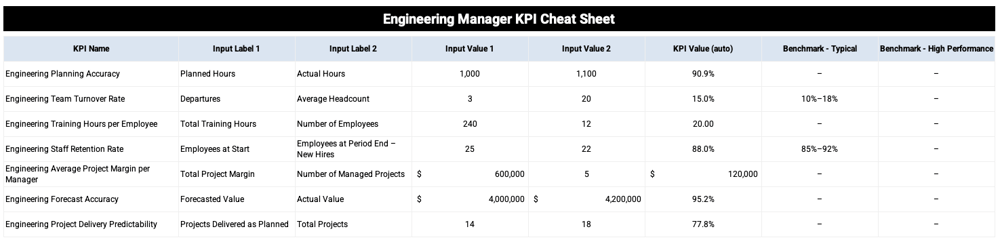
The Engineering Manager KPI Cheat Sheet emphasizes planning metrics that highlight project outcomes and team performance. Formulas and benchmarks include planning, utilization, turnover, training hours, and retention, all of which help managers evaluate and maintain team effectiveness.
How Engineering KPIs Work in Combination
Many KPIs interact with one another in meaningful ways, and understanding how they intersect and inform one another is just as important as calculating them in the first place. This section illustrates how different metrics combine to expose deeper performance trends. Different combinations of KPIs highlight risks, strengths, and inefficiencies.
The following combinations illustrate and explain how related engineering metrics reinforce each other. Evaluating KPIs by groups helps you gain clearer insight into performance and opportunities for improvement.
For a detailed and focused list of the most important Engineering KPI metrics, download The 10 KPIs Your Engineering Firm Needs to Be Tracking.
Utilization Rate + Net Multiplier + Profit Margin
This trio reveals whether a project-based engineering firm is converting labor into profit efficiently.
- High utilization + high multiplier + strong margin = healthy pricing, accurate scoping, well-deployed staff.
- High utilization + low multiplier = underpricing or excessive discounts.
- Low utilization + high multiplier = strong pricing but excess capacity.
- Low utilization + low margin = structural issues such as overspending, underbilling, or weak demand.
Realization Rate + Budget Variance + On-Time Delivery Rate
These KPIs together show project execution quality.
- High realization + low variance + on-time delivery = predictable, well-run projects.
- High realization + high variance = revenue captured, but at the cost of overruns.
- Low realization + low variance = projects are controlled but underbilled.
- Low delivery rate + high variance = systemic scheduling or resource bottlenecks.
PY (First Pass Yield) + Rework Rate
Core indicators of engineering quality and process stability.
- High FPY + low rework = strong design accuracy and review processes.
- Low FPY + high rework = quality issues, unclear requirements, or skill gaps.
- High FPY + high rework = inconsistent workflows or uneven team performance.
- Low FPY + low rework = artificially suppressed reporting or low output volume.
Change Order Rate + Client Satisfaction (CSAT/NPS)
Together, these show how well scoping aligns with client expectations.
- Low change orders + high CSAT = clear scoping and strong communication.
- High change orders + high CSAT = evolving project needs handled well.
- Low change orders + low CSAT = unmet expectations despite stable scope.
- High change orders + low CSAT = poor scoping or unclear deliverables.
Resource Utilization Rate + Employee Utilization Balance
A view into team workload health and sustainability.
- High resource use + balanced utilization = efficient staffing without burnout risks.
- High resource use + uneven utilization = bottlenecks, overreliance on key individuals.
- Low resource use + balanced utilization = stable but under-loaded team.
- Low resource use + uneven utilization = structural workflow or assignment issues.
Forecast Accuracy + Project Delivery Predictability
A leadership-level view of planning reliability.
- High forecast accuracy + predictable delivery = strong project controls and dependable planning.
- High forecast accuracy + poor delivery predictability = planning is accurate, but execution falters.
- Low accuracy + predictable delivery = teams deliver well, but planning inputs need refinement.
- Low accuracy + poor predictability = major planning and delivery risk.
Revenue per Employee + Utilization + Realization
A firm-level efficiency composite.
- High RPE + high utilization + high realization = highly efficient, productive firm.
- High RPE + low utilization = high-value contracts but underused staff.
- Low RPE + high utilization = pricing, scoping, or discounting issues.
- Low RPE + low realization = chronic leakage from write-downs or overruns.
Revenue Growth Rate + Backlog % + Win Rate
Indicators of market position and future stability.
- High backlog + strong win rate + positive growth = healthy pipeline.
- Low backlog + strong win rate = growing momentum but pipeline still rebuilding.
- High backlog + low growth = overreliance on existing work or slow business development.
- Low backlog + low win rate = high business development risk.
Best Practices to Make Engineering KPIs Actionable
KPIs are only truly useful when they drive intelligent, informed decisions. You need consistent names and definitions, reliable data flows, and agreed-upon review cycles. With benchmarks and goals, you can drill down to the root causes of problems and adjust course.
Here’s a best practices overview:
- Align KPIs with goals: Choose KPIs that directly support your strategic, financial, and operational priorities.
- Define formulas consistently: Ensure every team calculates KPIs the same way to avoid conflicting interpretations.
- Set benchmark targets: Use verified industry benchmarks or internal historical data to establish realistic performance thresholds. Benchmarks give context to raw numbers and help teams understand what “good” looks like.
- Review KPIs regularly: Incorporate dashboards into weekly, monthly, and quarterly business reviews, so you keep on top of them and make necessary course corrections.
- Drill down to root causes: When a KPI drops, investigate utilization gaps, pricing issues, scope drift, or staffing bottlenecks.
- Connect KPIs to actions: Pair each KPI with corrective steps (e.g., rebalance workloads, adjust fees, improve scoping).
- Visualize trends over time: Spot patterns early by trending KPIs rather than relying on one-time snapshots.
- Share results transparently: Give teams visibility into KPIs so they understand how their work affects outcomes.
For more on making your KPI data actionable, check out How to Track and Analyze AE Project Performance and KPIs.
How to Automate Your Engineering KPIs in BQE CORE
BQE CORE automatically captures the data behind your engineering firm's KPIs directly from your time, billing, project, and accounting workflows.
By centralizing this information, BQE Core’s engineering KPI dashboards and reports eliminate the need for manual spreadsheets. Dashboards update in real time, giving leaders instant visibility into trends, bottlenecks, and risks across projects, teams, and departments. You can compare performance across managers, track progress against targets, and drill into the drivers behind every KPI without exporting or manipulating data.
With BQE CORE, KPI insights become actionable: you can rebalance workloads, adjust fees, refine forecasts, and strengthen delivery as soon as the data changes, no month-end scramble required. It’s a faster, more accurate way to manage performance and keep projects, teams, and profit on track.
How CORE Simplifies KPI Tracking with Project KPI Power Up
Knowing firm leaders want to see their key performance indicators quickly and accurately, we have woven in features across the product to visualize where you stand. From project lists to role-based dashboards, you and your team can see the KPIs that matter most.
Engineering KPI FAQs
How many engineering KPIs should you have?
Most firms track 8-12 core KPIs that collectively measure resource use, delivery, financial performance, and quality. The key is to find the ones that you care about most and reflect true business outcomes. It's better to have a set that you track consistently than try to track every KPI available. The goal is to see performance trends over time so you can make adjustments to your operations.
What are the common pitfalls to avoid when setting up and tracking KPIs?
The most common pitfalls in setting up and tracking KPIs are unclear definitions of terms, inconsistent formulas, unreliable data, or KPIs that do not align with strategic goals.
How do we integrate KPI tracking into daily workflows and performance reviews without it becoming a burden?
Using automated dashboards, you can schedule weekly or monthly reviews and highlight performance trends rather than simply reviewing raw data. KPIs are best utilized to report information on existing workflows.
How do we get team members and leadership to buy into engineering KPI measurement?
The best way to create buy-in among team members is to choose KPIs that are consistently monitored, fairly implemented, and transparent. Tie KPIs to outcomes that appeal directly to different teams and departments and that give them useful, actionable information.