


Download free engineering invoice templates in multiple formats for all project types and billing methods. Learn how to meet compliance standards and simplify invoicing for any client.
In this article:
- Types of engineering invoice templates by billing model
- Types of engineering invoice templates by project
- Basic elements of any engineering invoice
- The Benefits of Using an Engineering-specific Invoice
- Compliance for engineering invoices
- How to Adapt Engineering Invoices for International Clients
- The easiest way to simplify engineering invoicing
- Engineering Invoice FAQs
Types of Engineering Invoice Templates By Billing Model
Engineering invoices vary by how firms structure project fees and track work. Typical invoice types include time and materials, lump-sum, cost-plus, unit-rate, and progress billing. Each template type addresses specific contract needs and client expectations, ensuring a clear, transparent billing process.
These engineering invoice templates cover the most common billing scenarios for engineering and construction projects. Each template includes the fields engineers require, with blank and filled-in examples to show how each template works in practice.
Time and Materials Engineering Invoice Template
%20Engineering%20Invoice%20Template.png?width=1429&height=1101&name=Time%20and%20Materials%20(T%26M)%20Engineering%20Invoice%20Template.png)
Example of a time and materials engineering invoice using this template.
Download Templates:
This time and materials invoice is best for hourly or daily billing situations where labor and materials vary by project. It is commonly used for fieldwork, inspections, testing, and consulting tasks.
The time and materials invoice example and template display fields for labor categories, names, rates, and total hours, with a separate section for material or equipment costs. In addition, there are optional markup fields for reimbursables and subconsultant pass-throughs.
Lump Sum / Fixed Fee Engineering Invoice Template
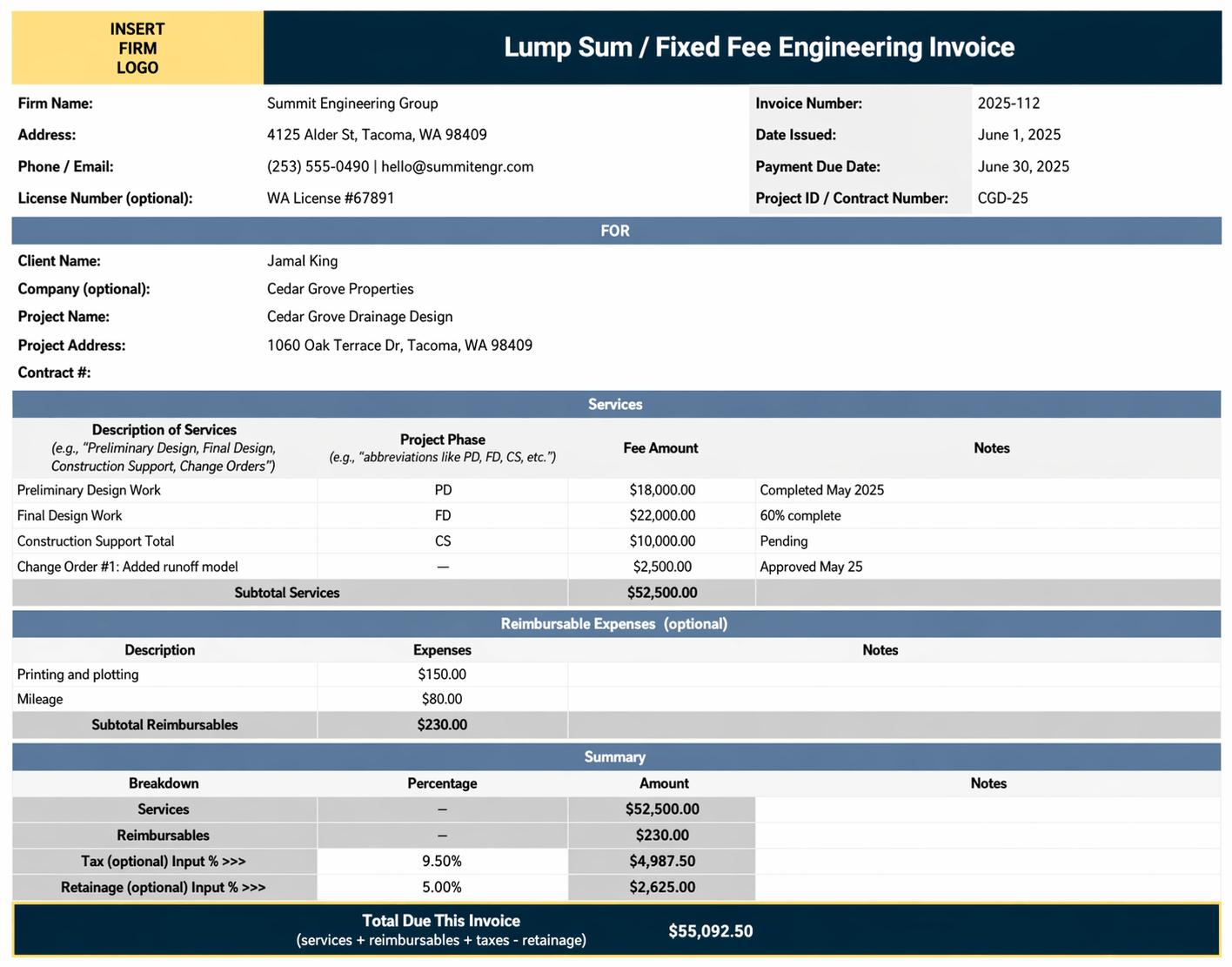
Example of a lump sum engineering invoice using this template.
Download templates:
Use the lump sum/fixed fee engineering invoice template for projects with a defined scope and total fee agreed upon in advance. It is ideal for design and planning work with predictable timelines for deliverables. This template is commonly used by consultants, architects, and firms operating under fixed-fee contracts.
The lump sum engineering invoice example and template include sections for project phases, descriptions of work, and completion percentages, providing a clear view of the work being billed. It features fields for milestone payments and retainage tracking, as well as optional lines for approved change orders.
For a detailed breakdown of phased-based invoicing, see our milestone billing article.
Cost-Plus/Fixed Fee (With Reimbursables) Invoice Template for Engineers
%20Engineering%20Invoice%20Template.png?width=1456&height=1080&name=Cost-Plus%20Fixed%20Fee%20(with%20reimbursables)%20Engineering%20Invoice%20Template.png) Example of a cost-plus (with reimbursables) engineering invoice using this template.
Example of a cost-plus (with reimbursables) engineering invoice using this template.
Download templates:
The engineering invoice template for cost-plus with reimbursables applies to contracts in which your client pays your firm for actual costs plus a fixed fee or percentage markup. This template is useful for government or institutional contracts that require detailed cost breakdowns. Firms that bill both labor and reimbursable expenses, such as travel, lab tests, or subconsultants, will find this especially useful.
The engineering cost-plus with reimbursables example and template include separate sections for labor, indirect costs, fixed fees, and reimbursables, as well as columns for markup rates and total amounts for each category. There are fields for vital information, such as the project ID, contract number, and funding source.
Unit Rate Engineering Invoice Template
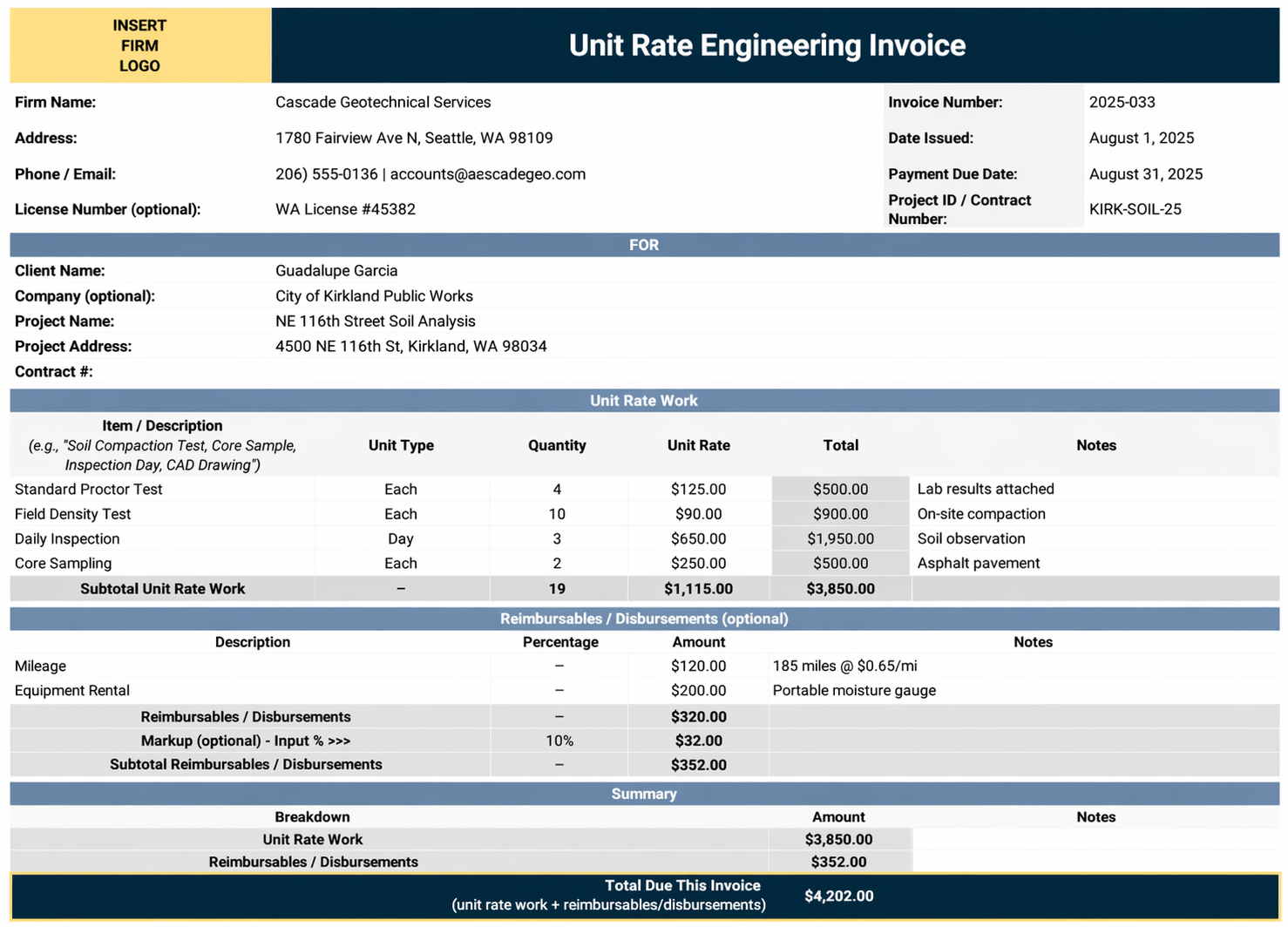
Example of a unit rate engineering invoice using this template.
Download templates:
This unit rate engineering invoice template is designed for billing projects per measurable unit, including tests, inspections, drawings, and site visits. Environmental and geotechnical engineers commonly use it, especially for repetitive tasks or for contracts that specify unit pricing.
The unit rate engineering invoice example and template show columns for unit descriptions, quantities, unit rates, and calculated totals. There are also optional fields for task codes and other project documentation. There is space for subconsultant or equipment charges, and the template automatically calculates subtotals and taxes.
Engineering Progress Billing Invoice Template
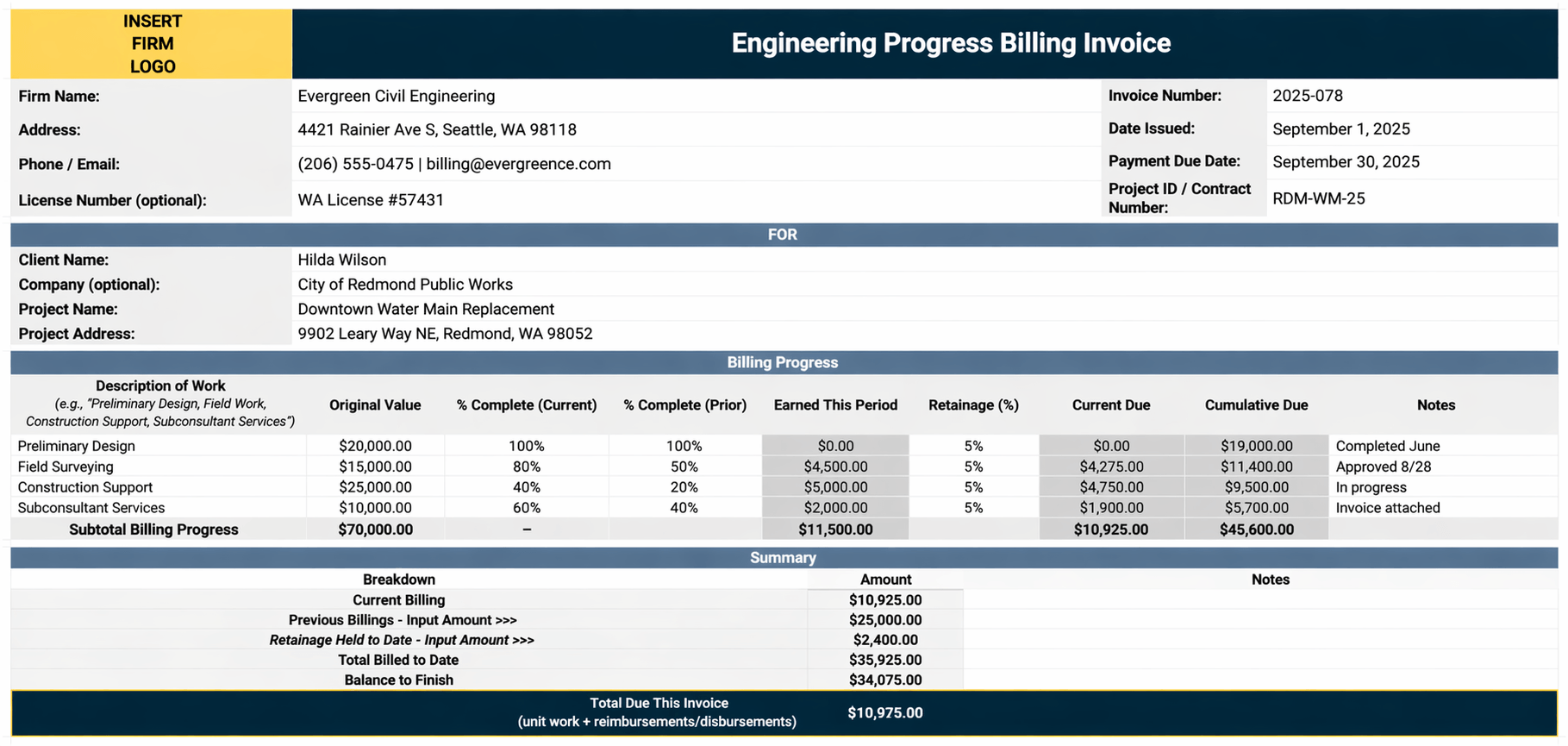
Example of an engineering progress billing invoice using this template.
Download templates:
Use the engineering progress billing invoice template for long-term or phased projects where you bill your client as work progresses. This template is commonly used for infrastructure, construction management, or design-build contracts. It’s also useful when clients pay based on the percentage of the job completed or milestones achieved.
The engineering progress billing invoice example and template feature fields for previous billings, current progress, and total billed to date. The template is especially useful for long-term projects. There is a schedule of values table for line item breakdowns of work and costs, and the template automatically calculates retainage.
See these detailed Progress Billing Template Samples for examples of how this invoicing works.
Schedule of Values Engineering Invoice Template
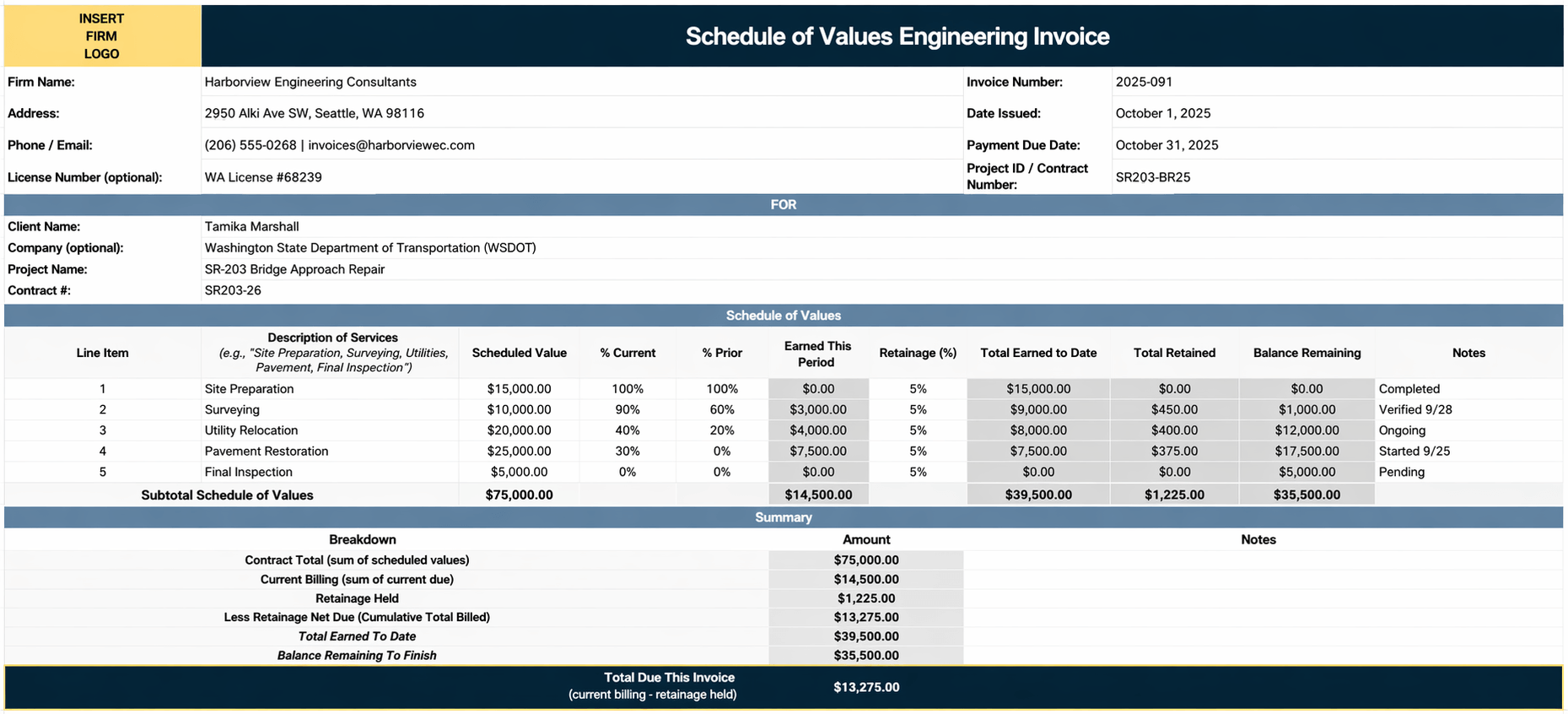
Example of a schedule of values engineering invoice using this template.
Download templates:
The schedule of values engineering invoice template applies to projects that break total contract value into specific tasks or phases, as is common in public works, construction administration, and multidisciplinary projects. Contracts tied to AIA or state DOT billing standards often require this type of invoicing.
The schedule of values engineering invoice example and template has a table listing tasks, dollar values, percent complete, and balance remaining, as well as columns for indicating current billing and cumulative billing amounts. With a built-in retainage tracker, it is useful for audit documentation as well.
Retainage / Retention Engineering Invoice Template
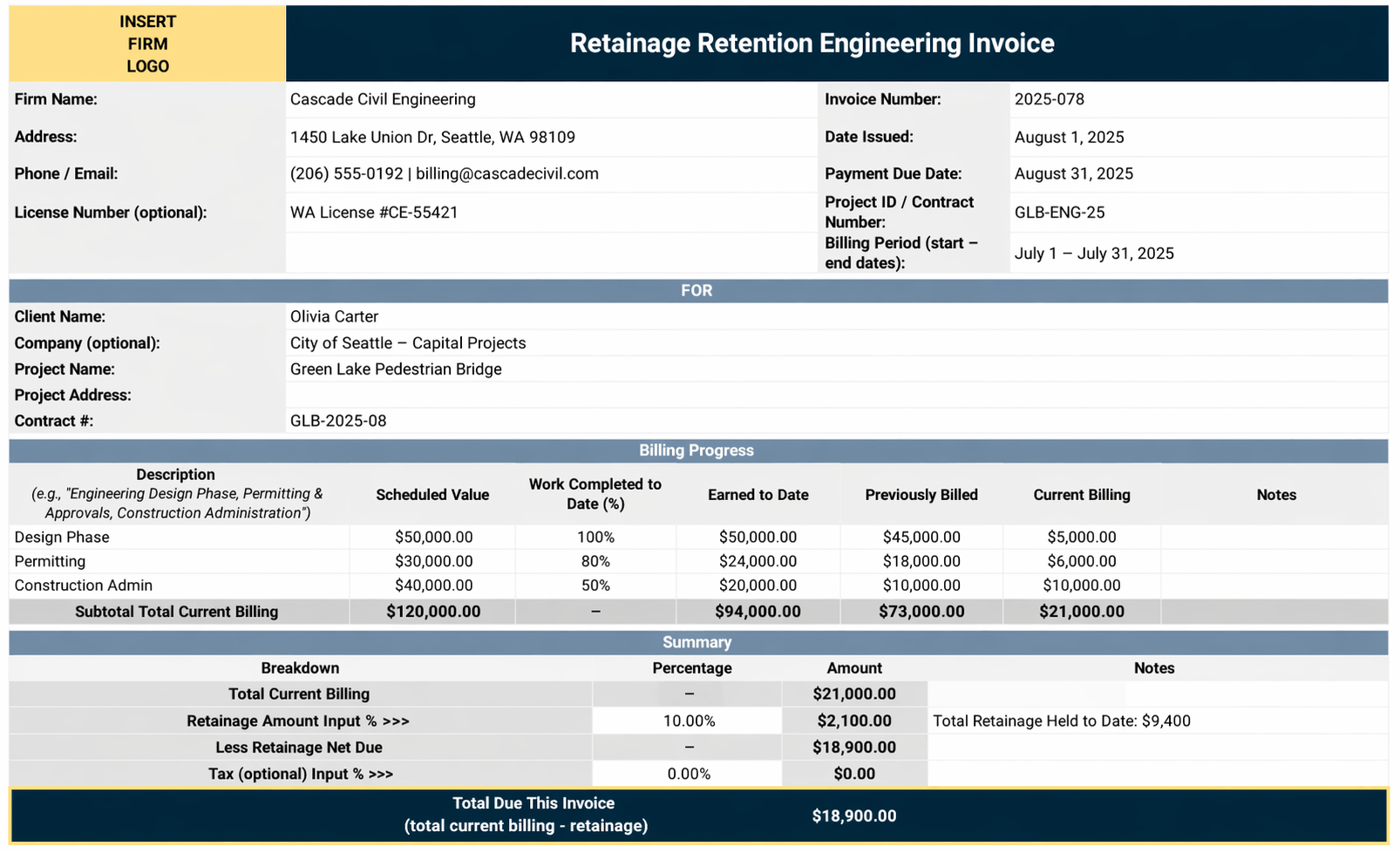
Example of a retainage/retention engineering invoice using this template.
Download templates:
Use the retainage/retention engineering invoice template for projects where a percentage of each payment is withheld until completion and sign-off. This is common in public works, construction management, and infrastructure contracts. This template helps your firm track amounts retained, released, and outstanding. It is helpful for compliance with AIA, FAR, and state DOT payments.
The retainage/retention engineering invoice example and template feature fields for total contract value, retainage rate, and retainage held. The columns show previous retainage, current release of funds, and remaining balance. Calculations for percent complete and total earned are automatic.
Reimbursables / Disbursements Engineering Invoice Template
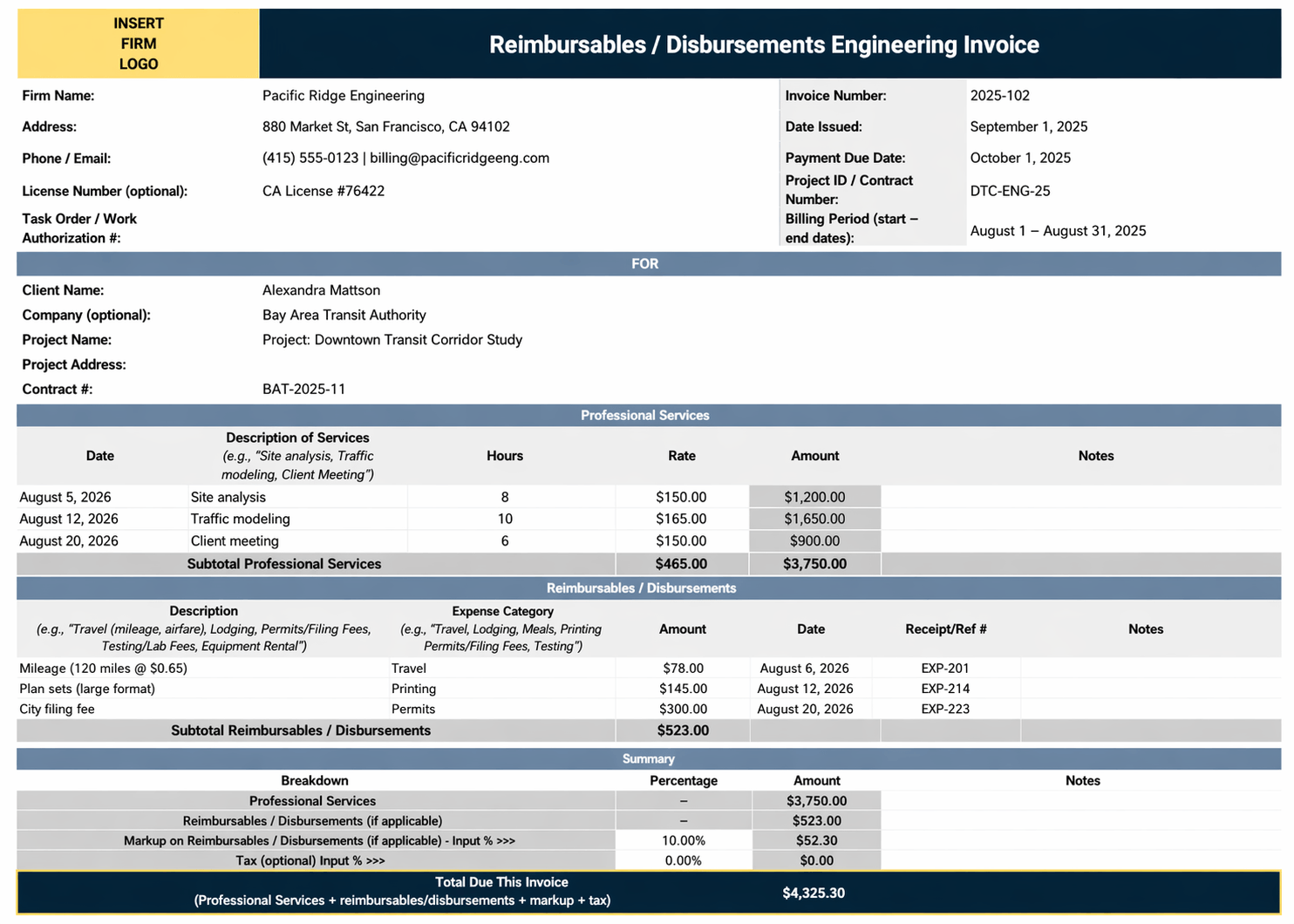
Example of a reimbursables/disbursements engineering invoice using this template.
Download templates:
This reimbursables/disbursements engineering invoice template works for billing project-related expenses that fall outside of labor or fixed fees, such as travel, rental fees, or subconsultant services. Engineers commonly use this type of invoice for cost-plus or time-and-materials contracts, where additional costs are reimbursed. It is ideal for contracts that reference ACEC guidelines or FAR Part 31 compliance.
The reimbursables/disbursements engineering invoice example and template feature an itemized table for expense type, date, description, and amount charged, with an optional markup percentage field for overhead or administrative costs. There are customizable sections for subconsultant invoices, receipts, and supporting documentation. Totals auto-calculate by expense category and project phase.
Change Order Engineering Invoice Template
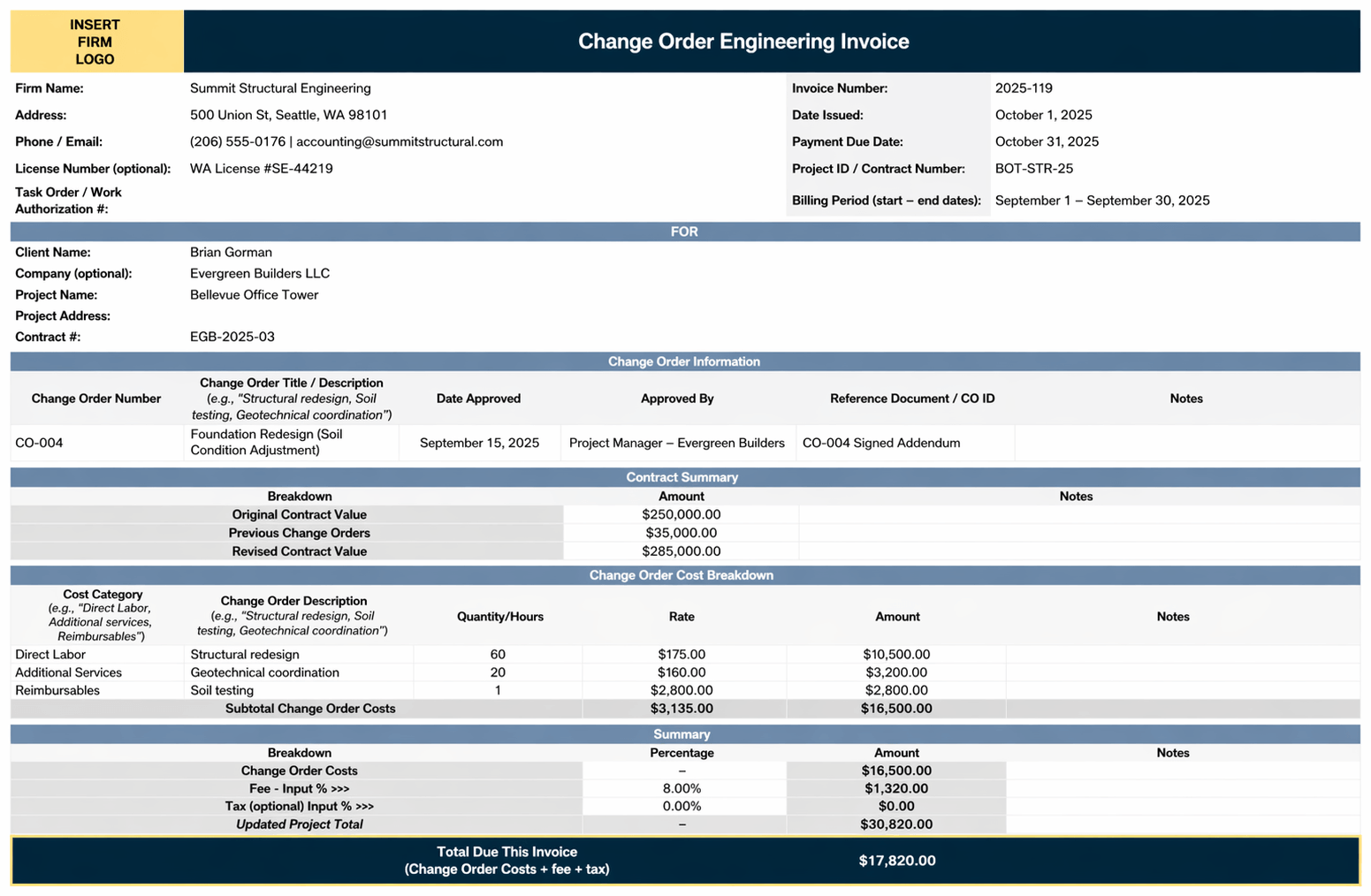
Example of a change order engineering invoice using this template.
Download templates:
Use the change order engineering invoice template to bill for approved scope adjustments or work that falls outside the original contract. It is commonly used on projects where requirements are in flux. The template is suitable for lump-sum and cost-plus agreements where the contract value can change.
This change order engineering invoice example and template have fields for the change order number, description of changes, date, and change approval signature. The template allows you to add line items for added labor, materials, or subconsultant costs. The template also has space for client authorization notes or to reference the original agreement, for clear record-keeping.
Retainer / Deposit Engineering Invoice Template
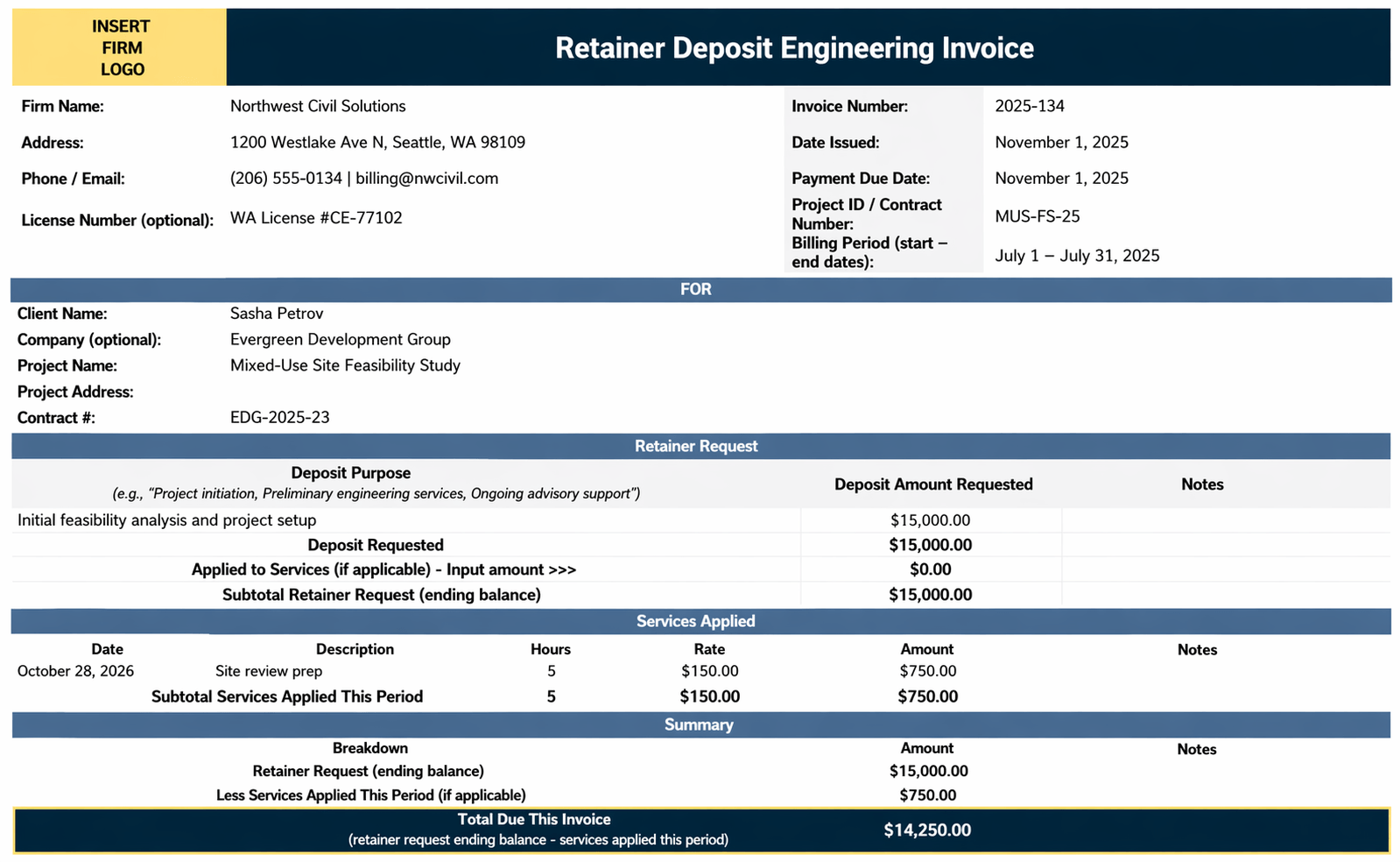
Example of a retainer/deposit engineering invoice using this template.
Download templates:
The retainer/deposit engineering invoice template is designed for collecting upfront payments before any contract work begins. That’s common with new clients, small private projects, and consulting work that requires an advance payment. It helps ensure funds are available before significant work begins.
The retainer/deposit engineering invoice example and template have fields for retainer amount, date received, and balance, with optional fields showing the offset on future invoices. There are columns for payment method and transaction reference information as well.
Types of Engineering Invoice Templates by Project
Using the right invoice template for your engineering project improves billing payment clarity and accuracy. The templates vary by project type, and each has the proper billing rules, standards, and features to meet client expectations for each type of project.
These engineering invoice templates include fields and formulas specific to your project type. From contract numbers and cost codes to reimbursable expenses and progress tracking, the templates are comprehensive and downloadable with blank and filled-in examples for your reference.
Public Works Project Engineering Invoice Template
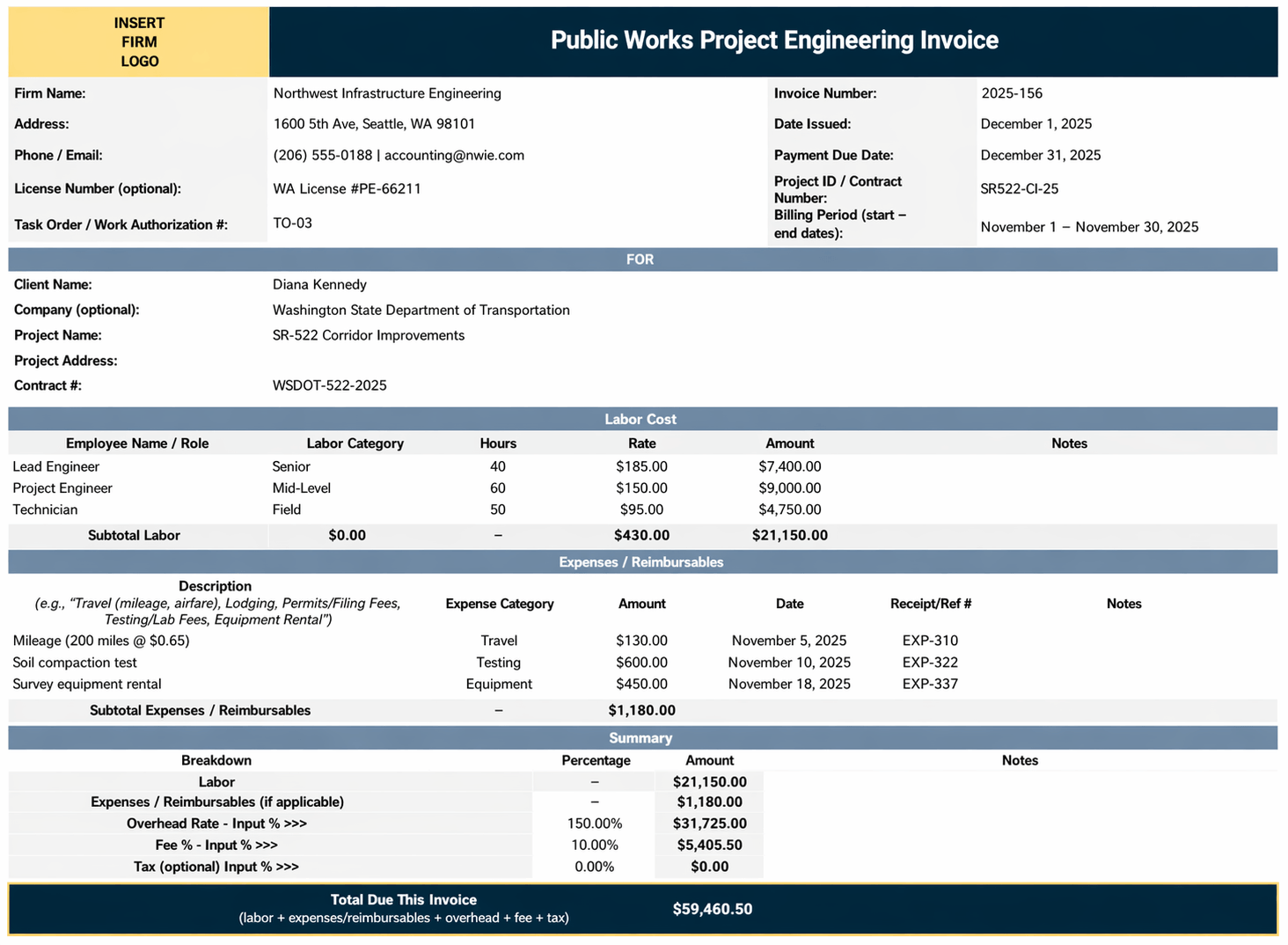
Example of a public works project engineering invoice using this template.
Download templates:
This public works engineering invoice template applies to government-funded or municipal engineering projects such as transportation, utilities, or infrastructure work under public contracts. It is especially useful for projects that must meet strict documentation and compliance requirements for audits or payment release. It is suitable for firms working under FAR Part 31, DCAA, or state DOT guidelines.
The public works engineering invoice example and template show fields for project title, contract number, finding source, and agency contact, as well as sections for progress billing and reimbursable expenses. There is an optional schedule of values table and built-in compliance notes referencing FAR, ACEC, and DOT standards.
Architectural Design Project Invoice Template for Engineering
.png?width=1482&height=1061&name=Architectural%20Design%20Project%20Invoice%20Template%20(for%20Engineering).png)
Example of an architectural design project invoice for engineering using this template.
Download templates:
The architectural design project template is perfect for engineering teams working under architect-led and multidisciplinary contracts. It commonly applies to building design, renovation, or mixed-use development projects. The template supports milestone billing to align with architectural schedules.
The architectural design project example and template feature sections for schematic design, construction documents, design development, and administration costs and notes. There are columns indicating percent complete, current billing, and cumulative totals.
Small Private Project Engineering Invoice Template
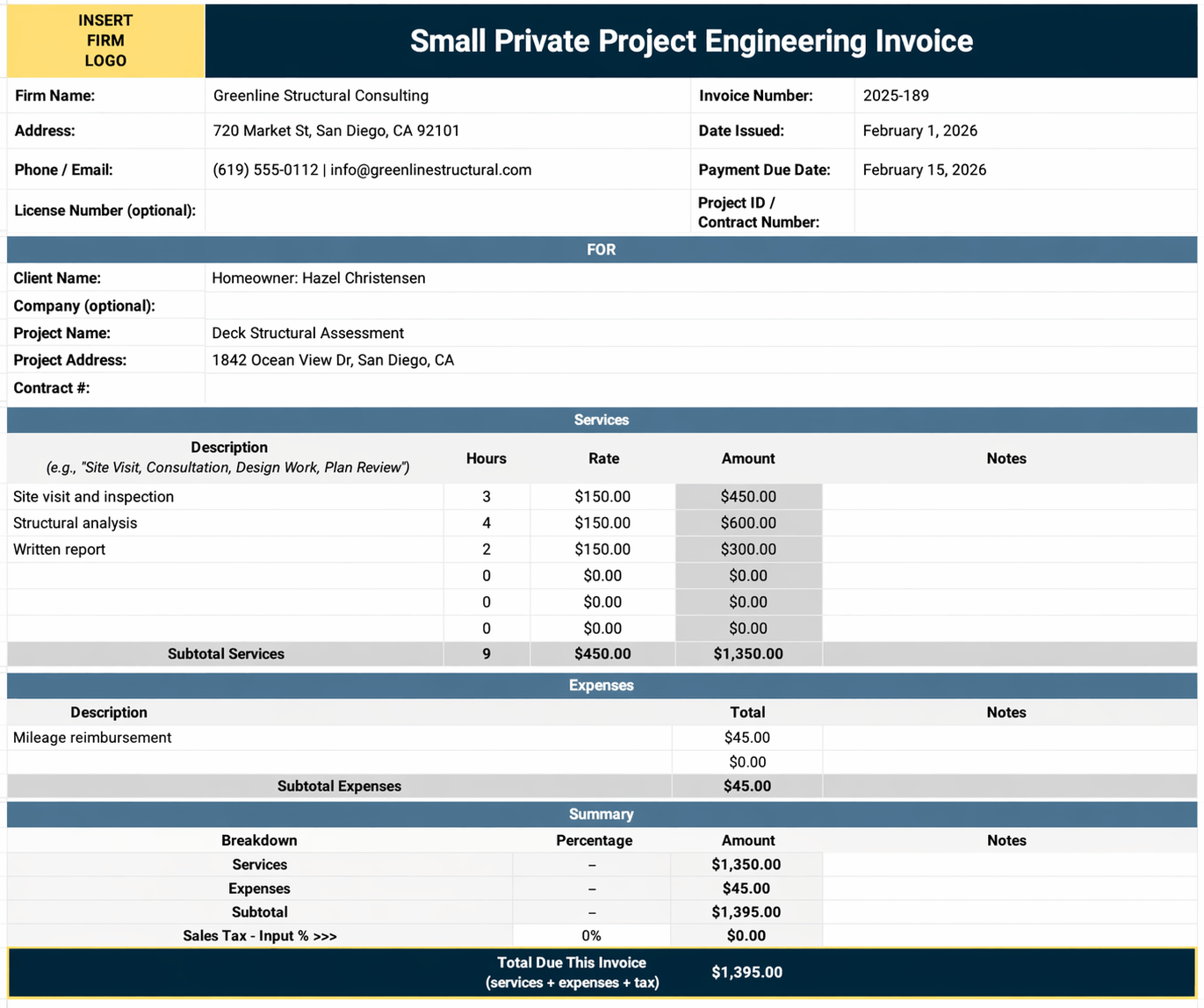
Example of a small private project engineering invoice using this template.
Download templates:
Use the small private project engineering invoice template for small commercial or residential jobs with limited scope or complexity. It works for single-site assignments, drainage studies, or short design or renovation tasks. It is well-suited for freelance engineers or small firms.
The small private project engineering invoice example and template have a simple layout with fields for labor, materials, reimbursables, and total due. The template displays fields for project identification, client contract details, and invoice dates. It is easy to customize for time-based or fixed-fee billing.
Basic Elements of Any Engineering Invoice
Engineering invoices should include project and billing details to support industry compliance, accuracy, and timely payment. Unlike generic invoicing templates, engineering-specific templates have fields for reimbursables, retainage, and progress data.
The elements below are basic to any engineering invoice and make billing easier to track and payments easier to manage:
- Company Info: Include your firm’s name, contact details, license number, and any business registration information.
- Client and Project Info: List your client’s name and contact details, project title and contract number, and other relevant information.
- Invoice Details: Record invoice information such as invoice number, payment date and payment terms.
- Description of Services: Provide details of work performed. Include quantities, hours, and milestones achieved.
- Reimbursables and Markups: List reimbursable expenses such as travel fees, equipment costs, or printing.
- Financial Summary and Totals: Summarize charges, past payments, retainage, and total due.
- Payment Methods: List acceptable payment methods, including links to online payment options.
The Benefits of Using an Engineering-specific Invoice
Engineering-specific invoices ensure compliance and accuracy, and they project professionalism to clients through specifically tailored content and design. Unlike generic templates, these invoices are specialized and designed with fields for progress billing, reimbursables, and retainage, helping you meet regulatory standards and present a clear billing process.
Below are some of the main advantages of using engineering-specific invoice templates:
-
Accuracy and Compliance: Engineering invoices include FAR part 31 rules, ACEC fee structures, and DOT-approved format, ensuring everything is documented properly for audits and billing.
-
Professionalism: Engineering disciplines such as civil, structural, MEP, geotechnical, and environmental are considered when creating the templates. This gives each invoice a polished appearance and conveys professionalism to your clients.
-
Progress Billing: Engineering-specific templates include progress billing sections that monitor work accomplished, retainage held, and task completion percentages to ensure that invoicing corresponds with contract milestones.
-
Prebuilt Fields. Unlike general templates, engineering-specific invoice templates include fields for markups, subconsultant fees, and reimbursables. This expedites invoice production and billing and streamlines reporting, particularly when used with e-billing payment systems.
Compliance for Engineering Invoices
Engineering invoices generally must follow rules set by the federal government, the state, or industry. Engineers need to adhere to frameworks such as FAR part 31, ACEC standards, or DOT formats to ensure documentation meets audit and reporting requirements.
Below are the most common compliance situations engineers face, along with tips on adapting invoice templates to meet those standards:
-
FAR Part 31: Federal Acquisition Regulation (FAR) Part 31 covers which expenses and charges can be billed on federal projects and how. Invoices must itemize and separate labor, indirect costs, and unallowable expenses to comply with this regulation
-
State Standards: Some states have specific requirements that may require adjustment of your invoicing templates. For example, in California, public contracts require itemized wage and material details. Always check industry standards when working across state lines.
-
ACEC Fee Guidelines: The American Council of Engineering Companies (ACEC) guidelines call for consistency in billing for reimbursables, markups, and overhead rates. Ensure that your invoices reflect and align with industry standards.
-
DOT Invoice Formats: Many state departments of transportation require specific invoice formats for different contract types. These vary by state, but typically include standards for progress billing, cost-plus fees, and subconsultant pass-through fees.
-
AIA Contract Documents: The American Institute of Architects maintains specific standards for engineering invoices on architect-led engineering contracts. These standards include phased-based line items, retainage tracking, and progress percentage reporting. For more, see our article on AIA Invoicing.
-
How to Adapt Invoices: Should you need to adapt an invoice to meet the standards of any of the above frameworks, the key is to delineate the affected information clearly. Add separate sections for direct, indirect, and reimbursable costs. Be sure contract numbers are easy to find. Include project identification information, and apply required markup or retainage fields. Use terminology specifically called for in the governing documents or contracts.
How to Adapt Engineering Invoices for International Clients
When working with clients in other countries, your invoices will need adjustments to meet international tax and currency standards. Generally speaking, you should have template fields for VAT or GST and note which currency you are using. This helps payments go smoothly across borders.
The UK requires your VAT registration number. Include that along with the rate applied and show the total calculated VAT amount in its own field, so it is easy to locate. For any VAT-exempt services, list them separately. These simple steps keep your invoice compliant and easy to use for both your client and your billing department.
Australia requires that you include your ABN (Australian Business Number) and that your invoice document must be labeled “Tax Invoice.” Be sure to show the GST separately from other charges. Invoices over AUD $1,000 may require information about the client’s identity or ABN. Check for updated information at https://www.ato.gov.au/.
It’s also smart to add a currency field (USD, GBP, AUD, or EUR) and include both pre-tax and total amounts. Setting up a version of your invoice for international work, especially if you accept online or e-payments, helps your team stay compliant, reduces back-and-forth over tax issues, and keeps cash flow steady.
Easiest Way to Simplify Engineering Invoicing
Billing for engineering projects can be complicated, involving various job phases, tax situations, and subcontracts. BQE Core billing software automates the process and takes the guesswork out of your invoicing. It saves time, lessens errors, and speeds up payment.
With BQE Core, areas like your schedule of values update automatically as work progresses. Retainage is easily tracked across invoices, and markups are applied. Our built-in dashboards show real-time KPIs, including DWO (days work in progress) and net multiplier, giving you an overview of your financial situation.
Learn more about Engineering KPIs like realization rate, net multiplier, and days sales outstanding (DSO).
Simplify your workflow and get paid faster with BQE CORE.
Engineering Invoice FAQs
How do engineers bill clients?
Engineers typically bill by time and materials, fixed fee, cost-plus, or progress billing, depending on the contract and the structure of the actual work.
What is a schedule of values in engineering billing?
A schedule of values lists each phase of a project with its assigned cost and helps document progress and calculate partial payments.
How is retainage handled in engineering invoices?
Retainage is a small portion of the payment held back until the job is finished. When projects have retainage, invoices show how much has been withheld and released so far and how much remains.
Why use an engineering invoice template instead of a generic invoice template?
Engineering templates include reimbursables, retainage, and compliance fields that standard invoices omit, making billing easier to review and approve.
How do FAR rules affect engineering invoices?
FAR Part 31 requires firms on federal projects to separate direct, indirect, and unallowable costs. Invoices must reflect that structure for compliance. If your firm is subject to Defence Contract Audit Agency scrutiny, invoices should adhere to FAR Part 31 rules.
How are structural engineering invoices different?
Structural engineering invoices often use design phase or milestone (schematic, drawings, or inspections) rather than billing by the hour or deliverable.
How are civil engineering invoices different?
Civil engineering firms typically rely on progress or unit-rate billing for large infrastructure work, with detailed cost codes and retainage tracking.
Can engineers bill for reimbursable expenses?
Yes. Travel, printing, permits, and subconsultant fees are commonly billed as reimbursables when allowed by the contract.
What software do engineers use for invoicing?
Many firms use BQE CORE to track time, automate their billing, and create project reports tied to KPIs.
Do engineering invoices include taxes like VAT or GST?
For international projects, invoices must show VAT or GST registration details and clearly separate the tax amount from the subtotal.